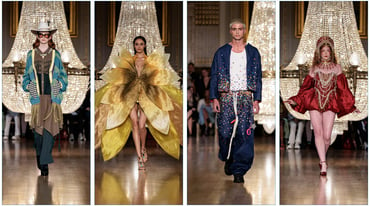

KYIV, Ukraine — Ukrainian Fashion Week will stage its spring 2027 season here from Sept. 2 to 6, fielding 50 designers in a program that treats commerce and craft as equally load-bearing. The lineup is anchored by Paskal, which opens the week, alongside Poustovit, Frolov, The Coat by Katya Silchenko, Gasanova, J’Amemme, Gunia Project and Ksenia Schnaider — a roster that has become the event’s institutional backbone since it resumed live shows in the capital following Russia’s 2022 invasion.
Kachorovska will host an emerging-designers prize this season, a signal that the market’s established names are underwriting succession planning even as the industry operates under wartime constraints. It’s a modest bet, but a deliberate one: talent pipelines don’t build themselves, particularly in a market that has spent three years absorbing supply-chain disruption and an exodus of design talent to London, Paris and Berlin.
The week’s centerpiece sits entirely outside the runway schedule. “Behind the Craft,” an exhibition at Mystetskyi Arsenal curated by Gunia Project’s Maria Gavryliuk and Natalia Kamenska, will present more than 70 pieces built around embroidery, weaving, beadwork and textile manipulation. The framing is as strategic as it is aesthetic: artisanal technique has become a differentiator for Ukrainian labels courting international buyers who can source volume elsewhere but not heritage craft, and its preservation has taken on added urgency as the war continues.
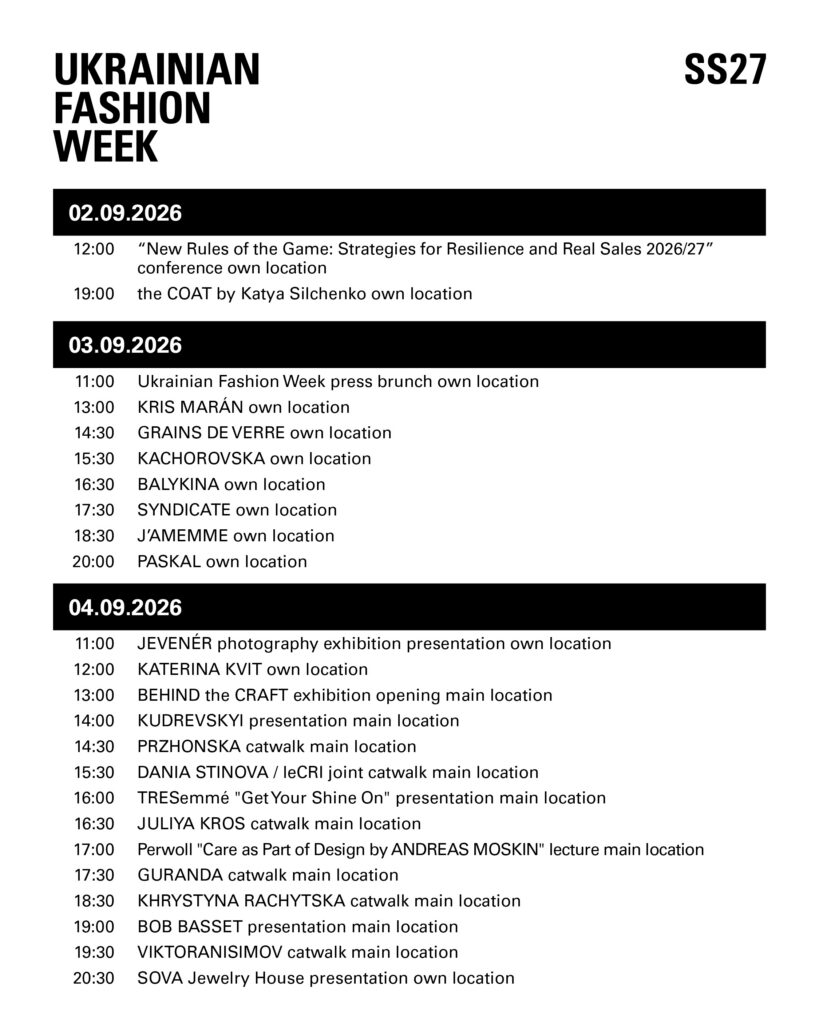
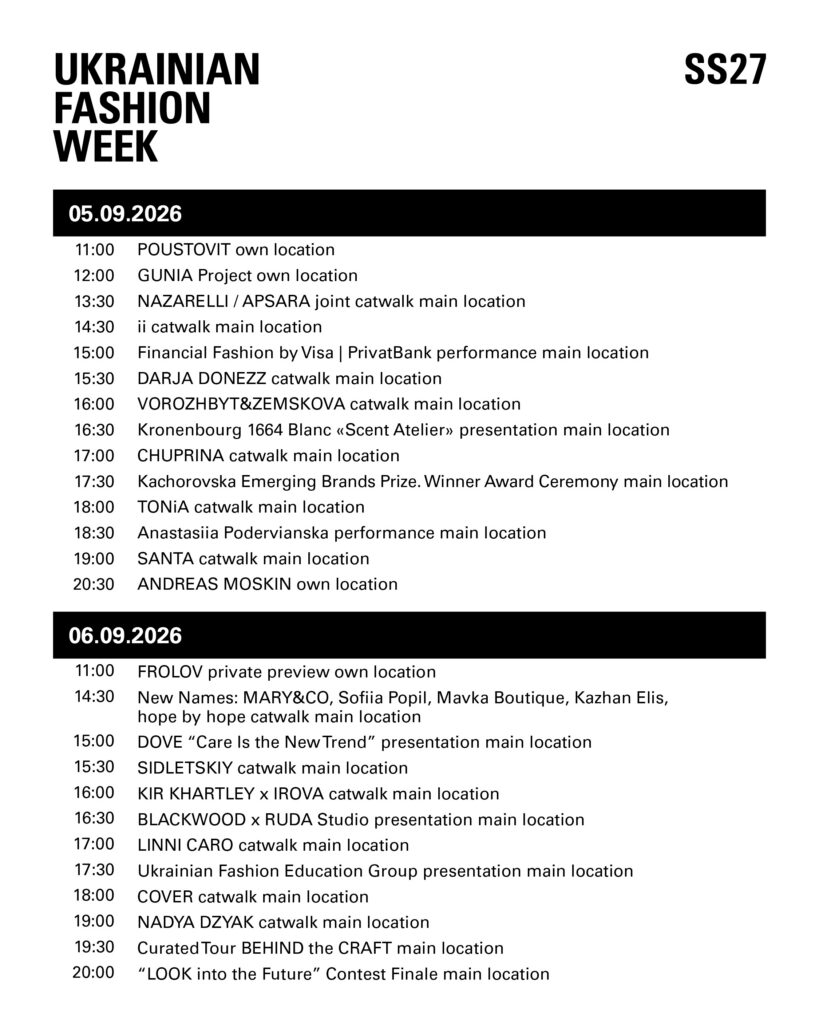
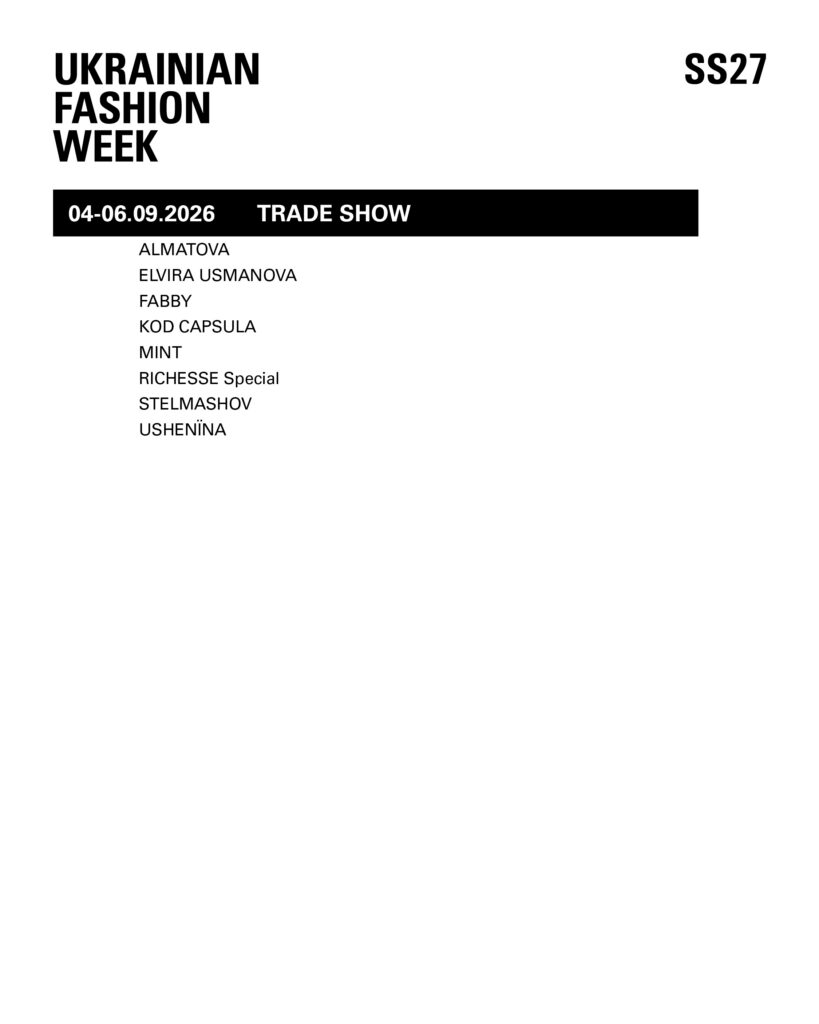
That business logic carries through to the week’s opening program at TSUM Kyiv, where sessions focus on domestic sales strategy, export expansion, and the mechanics of converting marketing spend into revenue — pointed programming for a design community still rebuilding logistics and distribution networks disrupted since 2022.
The week also extends past retail math. “Faces of Heroes,” run in partnership with the Yanko Charitable Foundation, will direct proceeds toward reconstructive surgeries for Ukrainian defenders — the latest instance of the event using its platform and audience to fund causes tied directly to the war.
Taken together, the September calendar reads as an industry declining to treat its wartime footing as a temporary interruption to business as usual, but as the operating context it now designs, sells and fundraises within. Buyers and press watching the Spring 2027 Shows will be looking for more than collections — this season doubles as a read on how much of Ukraine’s fashion infrastructure has been rebuilt, and how much still hinges on outside support.
Images courtesy of Ukrainian Fashion Week
The Coat by Katya Silchenko and the Growth of Ukraine's Export-Ready Labels
Among the week’s confirmed names, The Coat by Katya Silchenko has become a useful case study in how a Ukrainian label scales toward export markets during wartime. The brand, built around structured outerwear and considered tailoring, has spent the past several seasons expanding beyond the domestic wholesale accounts that once anchored it, adding stockists and direct-to-consumer channels in Western Europe as logistics routes through Poland and Romania have stabilized.
That trajectory mirrors a broader shift among the week’s established participants. Labels that once relied primarily on the Kyiv retail calendar are now structuring collections with international buyers in mind from the design stage, not as an afterthought once samples are finished. Production timelines have been rebuilt around longer lead times and diversified manufacturing, a response to the supply-chain disruptions that followed 2022.
Silchenko’s presence on the SS27 schedule, alongside Frolov and Gasanova, signals that this export-oriented approach is no longer experimental within the Ukrainian market. It has become close to standard practice for any label with ambitions past the domestic audience, and it is likely to shape how buyers evaluate the September lineup.
TSUM Kyiv's Expanding Role Beyond Retail Space
TSUM Kyiv’s involvement in Ukrainian Fashion Week has moved well past serving as a backdrop for opening events. The department store has increasingly positioned itself as a working partner in the industry’s commercial recovery, hosting the sessions on domestic sales strategy and export planning that open this season’s program.
That role reflects TSUM’s own function within the local market. As one of the few large-format retail spaces in Kyiv still operating at full capacity through the war, it has become a proving ground for Ukrainian labels seeking shelf space alongside international brands, a signal to buyers that a designer has cleared a basic threshold of commercial viability.
For Ukrainian Fashion Week, the partnership does practical work as well. It gives the event a retail-facing venue for programming aimed squarely at revenue, distinct from the runway shows and the Mystetskyi Arsenal exhibition. The arrangement suggests that the week’s organizers view retail infrastructure, not just runway visibility, as central to what Ukrainian designers need most right now: buyers who convert into repeat wholesale relationships rather than one-season press coverage.
International Buyers and Press: What Access Looks Like for SS27
For the global audience following Ukrainian Fashion Week from outside the region, access has become more structured with each season since live shows resumed in Kyiv. International press and buyers unable to travel can follow the SS27 schedule through the event’s official channels, with select shows livestreamed and lookbooks distributed to registered industry contacts shortly after each presentation.
That remote infrastructure matters for a market still working to rebuild the in-person attendance it lost after 2022. Several buyers who once traveled to Kyiv now split coverage between the physical week and its digital output, a compromise that keeps Ukrainian labels visible to markets in Western Europe and North America without requiring travel into an active conflict zone.
Accreditation for press and buyers is typically handled through Ukrainian Fashion Week’s organizing body in the weeks before the event, with priority given to outlets and retailers with an existing history covering or stocking Ukrainian designers. For a New York-based audience, that pipeline has become one of the more reliable ways to track which labels, beyond the established names like Poustovit and Ksenia Schnaider, are positioning for wider export in the coming seasons.