

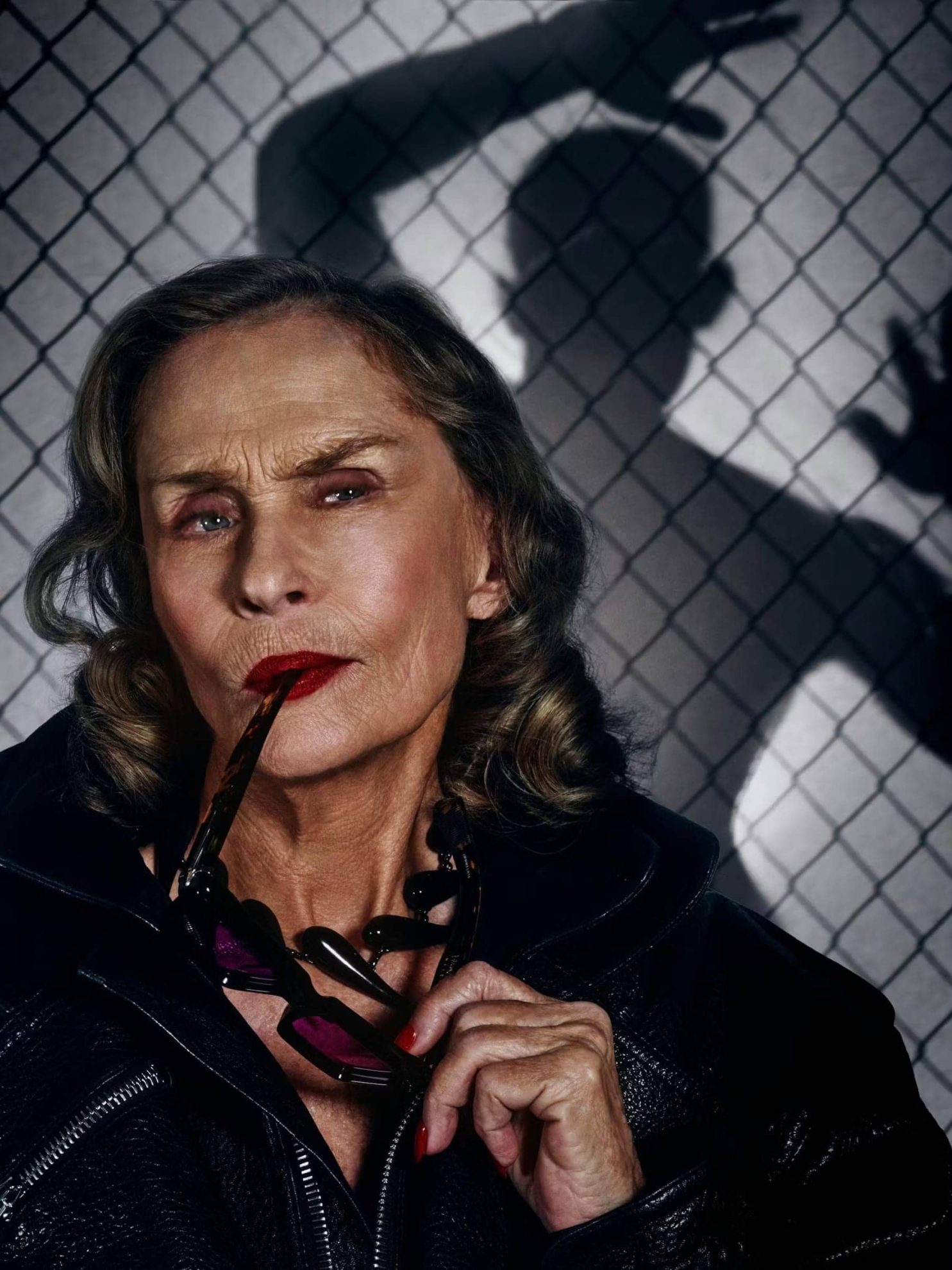
The cigarette smoke rises first. Then the chain-link fence comes into focus, a grid of shadows pressing against skin that has lived a whole century’s worth of stories. Lauren Hutton stares straight through mirrored lenses, and there is nothing accommodating in her gaze. This is not a woman selling sunglasses. This is a woman who has decided precisely who she is, and who dares you to argue.
Welcome to Spring 2026 at Jacques Marie Mage.

- Jacques Marie Mage’s Spring 2026 campaign pairs founder Jérôme Mage with creative director Haider Ackermann, yielding three handcrafted frames shot by Steven Klein with Lauren Hutton starring.
- Klein’s imagery trades luxury polish for psychological tension: chain-link fences, bruised blue lighting, distorted overlays, and shadow figures that turn eyewear into emotional armor.
- The collaboration signals a clear shift in positioning for the Los Angeles house: JMM is no longer just an eyewear brand. It is constructing its own cinematic universe.
The Los Angeles eyewear house has built its reputation on an insistence that frames are artifacts first, accessories second. Handcrafted through a 300-step process employing nearly 100 expert craftspeople, each pair arrives less like a product and more like a proposition: that what you choose to wear over your eyes says something permanent about character. For this campaign, titled “The Velvet Stare,” founder Jérôme Mage brought in Haider Ackermann as creative director and handed the lens to Steven Klein. The result is a sustained argument, made in bruised blues and claw-like shadows, for glamour as a psychological state rather than a surface effect.

How Haider Ackermann Reshaped the JMM Aesthetic
Ackermann’s fingerprints are everywhere in this campaign, though not in the ways you might expect. The Colombian-born French designer, currently steering Tom Ford through his second decade of sensual tailoring, did not arrive at Jacques Marie Mage with a mood board of obvious references. He arrived with a sensibility: the belief that clothing, and by extension the objects that complete it, should register something emotional before they register something beautiful.
In conversation with Highsnobiety, Jérôme Mage called Ackermann “one of the best creative directors in the world,” and the framing is deliberate. This was never a licensing arrangement. The three frames Ackermann co-designed with the house represent a genuine meeting of philosophies: his architecturally charged restraint sitting inside JMM’s obsessive material processes. The Melchior, a rectangular silhouette in sculptural ten-millimeter-thick bio-acetate, carries subtly nautical metal accents along its browline. The Balthazar features a rounder acetate front and anchors it with slim beta-titanium temples engraved with JMM’s signature arrowhead motif. The Gaspard, the most pared-back of the trio, works entirely in lightweight beta titanium, its rectangular form unified by a distinctive monobrow and hairline detailing that reads as structural poetry.
Where the collaboration truly exceeds expectation is in the leather-wrapped CUIR editions of the Melchior and Balthazar. Black leather wrapping applied to the frame’s front transforms the glasses into something closer to sculpture than to optics. Having studied Ackermann’s work at Berluti and his Tom Ford debut, which opened with two head-to-toe leather looks, the decision reads as a coherent biography translated into eyewear.

Steven Klein’s Lens: When Luxury Advertising Goes Noir
Steven Klein has built a career on the kind of imagery that unsettles before it seduces. Advertising commissions elsewhere might have pushed toward clarity, gloss, the kind of controlled perfection that reads aspirational from a hundred yards away. Klein did something else entirely here.
The campaign imagery Klein photographed and directed embraces grain, distortion, and deliberate visual abrasion. Chain-link fences appear as compositional elements that suggest containment without submission. Shadow figures loom at the edges of frames, not quite resolved into threat, not quite resolved into safety. Blue lighting bruises skin and surface alike, turning what could have been a clean product shot into something that reads more like a film still from a psychological thriller that doesn’t exist yet but absolutely should.
The Impression’s review, published May 11, 2026, noted that Klein “resists the sterile precision that often dominates luxury eyewear advertising, instead embracing grain, blur, and visual abrasion.” In a luxury market currently flooded with campaigns lit as if the sun itself has been art-directed into submission, Klein’s willingness to operate in murk feels subversive. Productive subversion: the kind that makes the product more desirable precisely because it refuses to display it easily.
The recurring phrase “the velvet stare” that JMM threads through the campaign’s language captures this contradiction with unusual precision. Velvet suggests softness, intimacy, the warmth of fabric against skin. A stare is hard, unbreakable, resistant. Klein holds these two things in the same frame and refuses to resolve them. Which is, of course, exactly what the best luxury advertising does.

Lauren Hutton and the Case for Experience Over Youth
The casting decision here deserves its own conversation. Lauren Hutton, the model who remade American beauty standards in the 1970s by refusing to fix the gap between her front teeth and by insisting on brains alongside beauty, brings to this campaign something that no emerging face could approximate: the accumulated authority of someone who has negotiated the fashion world on her own terms and won.
What Hutton brings to Klein’s images is not nostalgia for her earlier decades. She is not here to serve as a historical reference. She is present in the images as someone who fully and forcefully exists in the now, which is a different and more powerful thing.
Within the context of the Spring 2026 collection itself, which draws heavily on David Bowie’s so-called lost years in Los Angeles during the mid-1970s, a period defined by “creative rupture and artistic transformation,” Hutton’s biography runs parallel. She was there. She lived through the same cultural ruptures. Where Bowie was reinventing himself as the Thin White Duke in the Hollywood Hills, Hutton was rewriting what it meant to be a working model in America. The campaign draws this historical thread without spelling it out, which is exactly the right move.

The “Cracked Actor” Collection: What the Frames Actually Say
The broader Spring 2026 collection from which this campaign emerges is titled “Cracked Actor” after Bowie’s documentary of that period, and the brand has organized it around distinct design philosophies corresponding to different eras of 20th-century style.
The Ackermann collaboration frames sit within this larger system as its most emotionally freighted entry. The 300-step construction process and the involvement of roughly 100 craftspeople across Japanese and Italian ateliers means that each pair represents something closer to a small manufactured object of art than a consumer product. The collector’s case alone, a black leather python-embossed exterior housing two hand-stitched Italian leather individual cases, arrives as its own statement about the relationship between packaging and value.
The CUIR editions push this logic to its limit. Black leather wrapping on eyewear is genuinely unusual at any tier. Here it functions as tactile intimacy, a phrase that captures precisely how the material choice mirrors Ackermann’s approach to tailoring: the insistence that fabric, whether on a jacket or over a frame, should be felt as well as seen.


Brand Positioning: What This Campaign Is Actually Selling
In the broader context of luxury eyewear, Jacques Marie Mage occupies a genuinely singular position. The market’s upper tier divides broadly between heritage European houses for whom eyewear is an extension of ready-to-wear licensing revenue, and independent artisan brands whose craft credentials frequently outpace their cultural ambitions. JMM is the rare house that takes material process as seriously as the first group and cultural storytelling as seriously as the second. This Ackermann collaboration, and the Steven Klein campaign that frames it, is the clearest evidence yet of how far that combination can take an eyewear brand.
What saves the campaign from collapsing under the weight of its own mythology is the discipline of the collaborators. Ackermann has never made work that privileges concept over wearability. Klein has never made imagery, however dark, that loses its formal coherence. Hutton has never performed anything she didn’t mean. All three, working with Jérôme Mage’s clearly defined brand cosmology, produce something that earns its mystique rather than simply claiming it.
Images Courtesy of Jacques Marie Mage
In other brand campaign news, Valentino Rockstud Pre-Fall 2026: Michele’s Roman Return