
FRANCESCA LIBERATORE,
Autumn Winter 2021/2022
FASHION HYPOTHESIS
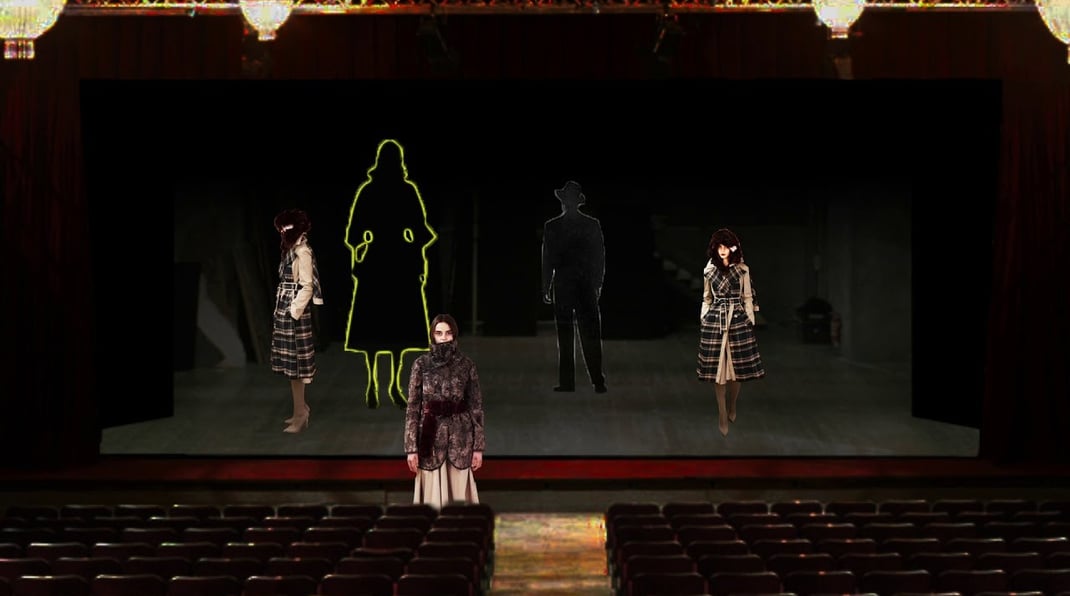
A post-war march becomes a collective acknowledgement toward a new future. The monologue by Mario Sesti, director and film critic, articulates what war and its uniform is; a fabric that interposes itself between body and violence, while 2D cut out models parade from a potential present. The garment becomes an actor portraying itself in the new language of Francesca Liberatore, and the public, the protagonist of their new life path. The camouflage of coated trench coats acquires a different perspective through the tuxedo with shawl lapels. High-waisted trousers are paired with a bolero in total black for a moment of stasis that already foreshadows a surge of 60s and 70s life with the swing of the super-tailored tartan trench coat. The story has the esprit of film noir, the mystery of an investigation. Maxi skirts and jackets alternate in increasingly wide proportions where the pattern becomes circular, and the fabrics metallic. Prints on gauzed wool with a shadowy palette of blue, black grey and Turkish red recall memories of the ’90s. The finale is the vision of six empty cases waiting to tell a story of the past, the lived life of manifested presences, white, ethereal, opulent, like ghosts of a possible future, moments of an ultimate luxury that yet does not yield. The story becomes pressing, accompanied by the soundtrack of classical pieces reinvented by the musicians from the Società dei Concerti with unsettling sound incursions. That sense of urgency, expressed so vividly in this 2021 collection, has only grown more relevant as fashion continues to interrogate its relationship with technology, nature, and identity through the mid-2020s. The choice Liberatore posed between a technology-governed dystopia and a nature-reborn future, framed then as speculative, reads in 2026 as remarkably prescient given the ongoing industry debate around AI-driven design and sustainable fashion practice. The hologram that pervades the scene is reminiscent of Utah’s extraordinary Pando Forest of golden poplars all generated from the same single immense root. The consciousness of what we are therefore passes through the essential, Country Roads, take me home!
Alessandro Turci
For more information please visit: https://www.francescaliberatore.it/
Liberatore's vision of fashion liberated from algorithmic control resonates strongly in 2026, as the broader industry grapples with regulating generative AI tools used in garment design and digital presentation.
The Creative Vision Behind Fashion Hypothesis
Francesca Liberatore framed her Autumn Winter 2021 2022 collection under the conceptual title Fashion Hypothesis, a designation that signals intellectual ambition as much as aesthetic intention. Working in collaboration with film critic and director Mario Sesti, whose monologue grounds the presentation in the language of cinema and conflict, Liberatore constructed a narrative framework that treats each garment as a performer rather than a product. This is fashion as dramaturgy, where the runway becomes a stage and the silhouette carries meaning beyond its cut.
The collection draws on a deliberately layered visual vocabulary. Coated trench coats rendered in camouflage speak to the military archive, yet are subverted by tuxedo shawl lapels that introduce an evening formality at odds with battlefield utility. This productive tension, between the functional and the ceremonial, runs through every look. High-waisted trousers anchored in total black give way to the kinetic energy of super-tailored tartan, signaling a tonal shift from stillness to movement. Liberatore treats proportion as argument, widening silhouettes progressively until the garment itself becomes an architectural gesture. The result is a collection that rewards close reading, a quality increasingly rare in an era of rapid digital consumption.
Material Choices and the Palette of Memory
The textile decisions underpinning the Francesca Liberatore Autumn Winter 2021 2022 collection are as considered as its thematic structure. Printed gauzed wool anchors several key looks, its semi-transparency lending a spectral quality that aligns with the collection’s recurring motif of presence and absence. The shadowy palette of blue, black, grey, and Turkish red operates less as a seasonal color story and more as an emotional register, recalling the saturated, slightly melancholic visual culture of the 1990s without resorting to direct quotation.
Metallic fabrics appear as the proportions widen and the narrative accelerates, functioning as a kind of punctuation. Where the opening looks establish introspection and restraint, the metallic passages announce urgency and transformation. The finale offers white, ethereal, opulent garments that conclude the collection’s arc with a vision of luxury stripped of ostentation. These closing looks, described in Alessandro Turci’s accompanying notes as ghosts of a possible future, read as both valediction and aspiration.
The reference to Utah’s Pando Forest, an aspen grove connected by a single vast root system, is not incidental. Liberatore invokes it as a metaphor for collective identity, proposing that individual expression in dress is only meaningful when understood as part of a shared biological and cultural inheritance. It is a quietly radical position for a fashion collection to stake, and one that has only grown more resonant since the collection’s debut.
Francesca Liberatore in the Context of Contemporary Fashion Discourse
Positioning the Francesca Liberatore Autumn Winter 2021 2022 collection within the broader fashion landscape reveals how prescient its concerns were. At a moment when the global industry was renegotiating the very format of fashion week presentation, forced by pandemic-related restrictions to experiment with film, digital installation, and hybrid formats, Liberatore chose not simply to adapt to new conditions but to interrogate them. The collection’s use of the monologue, the filmic narrative structure, and the 2D cut-out model format was not a compromise; it was a considered aesthetic argument about what fashion communication could become.
The ongoing industry conversation around artificial intelligence in garment design, digital-only presentation, and the ethics of algorithmic trend forecasting all find their philosophical counterpart in what Liberatore articulated in 2021. Her framing of a choice between a technology-governed dystopia and a nature-reborn future was speculative at the time; by the mid-2020s, it reads as a precise diagnosis of pressures the industry is actively navigating.
For global fashion audiences, particularly those who follow Italian ready-to-wear with attention to conceptual coherence alongside craft, the Autumn Winter 2021 2022 collection remains a reference point. It demonstrates that a designer working outside the commercial pressure of the major conglomerate system can produce work that is simultaneously rigorous, wearable, and genuinely forward-thinking.