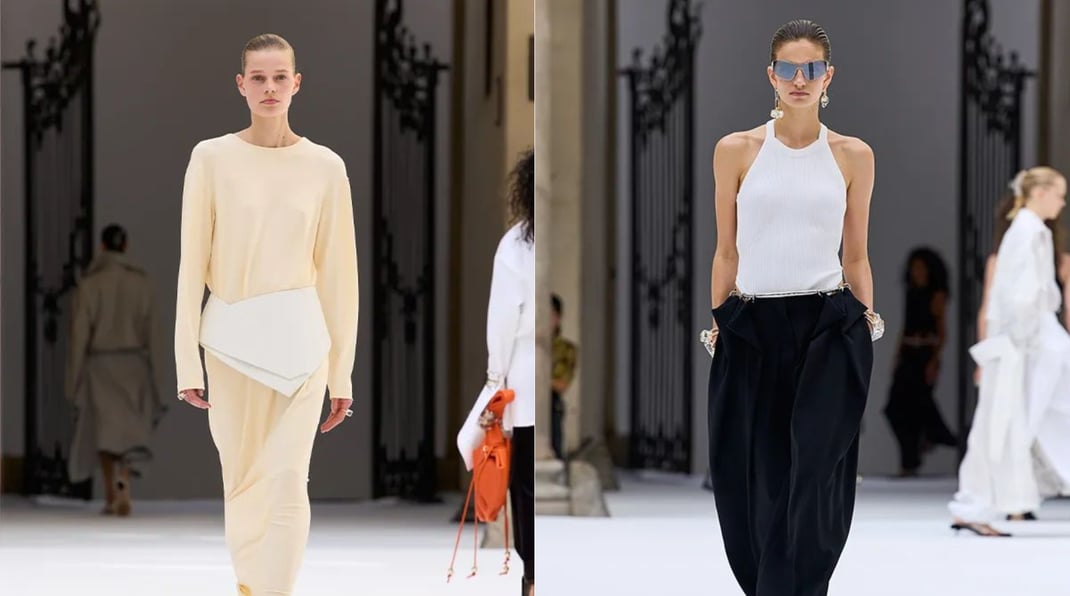

Sportmax showed 38 looks for Spring 2027 in the courtyard of Palazzo Litta in Milan on Sept. 25. The studio’s brief was heat-wave dressing: armless outerwear, layered silk organza, a suit rebuilt in voile, suede, nappa and lyocell denim. The commercial argument sits in the sheer tailoring and the Lucite and glass accessories, not in the leather
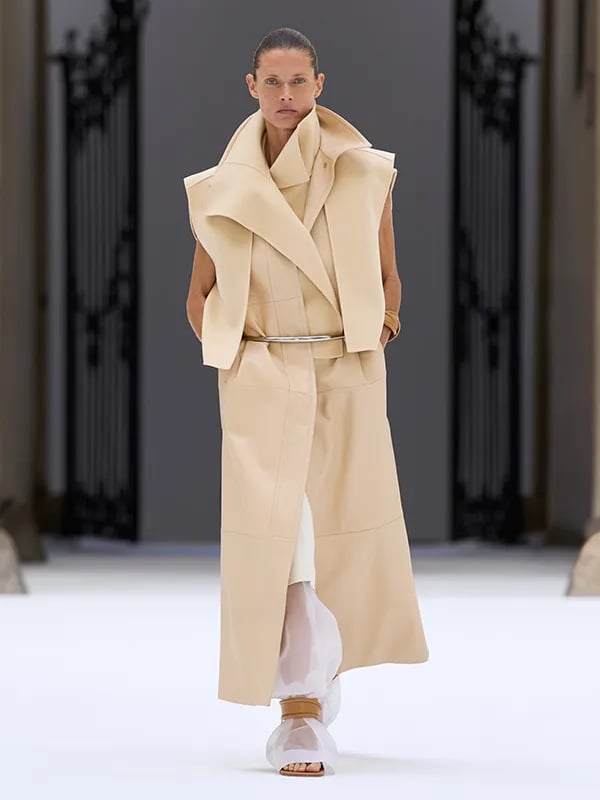
MILAN — Sportmax showed 38 looks in the courtyard of Palazzo Litta on Sept. 25, and used the Spring 2027 runway to argue that lightness is a construction problem rather than a mood. The evidence sat in tailoring: a suit rebuilt in pinstripe voile, viscose and wool, its open panels cut so the layer beneath read as part of the garment.
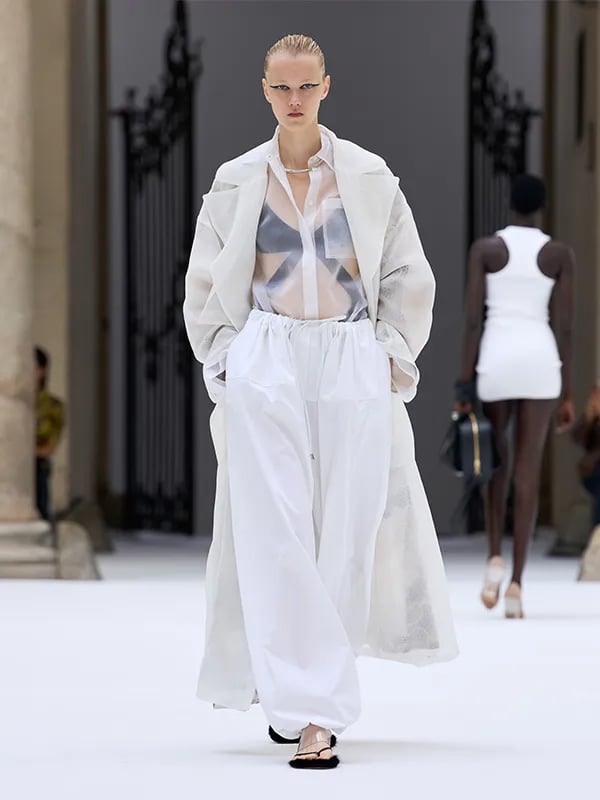
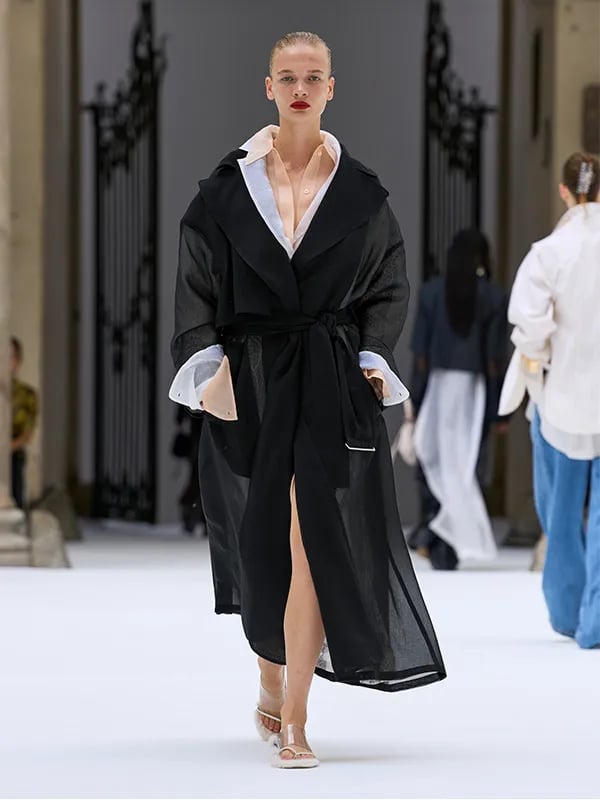
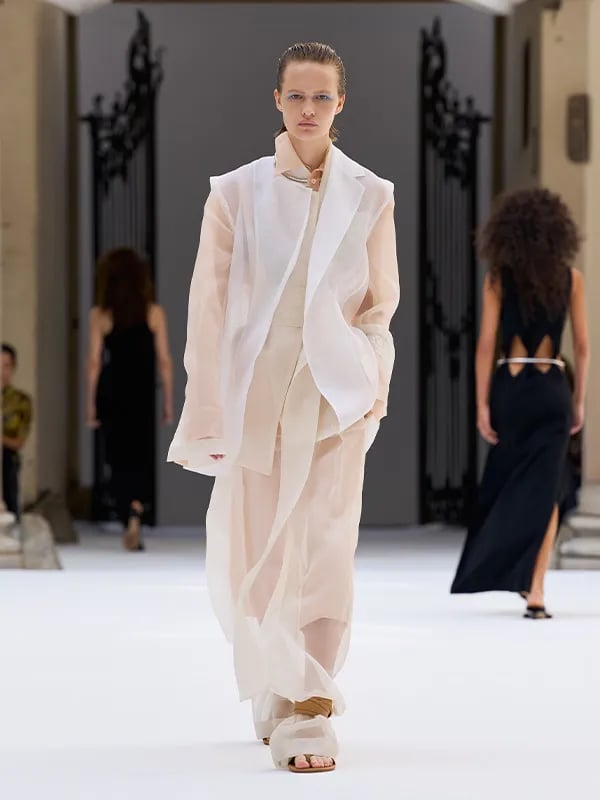
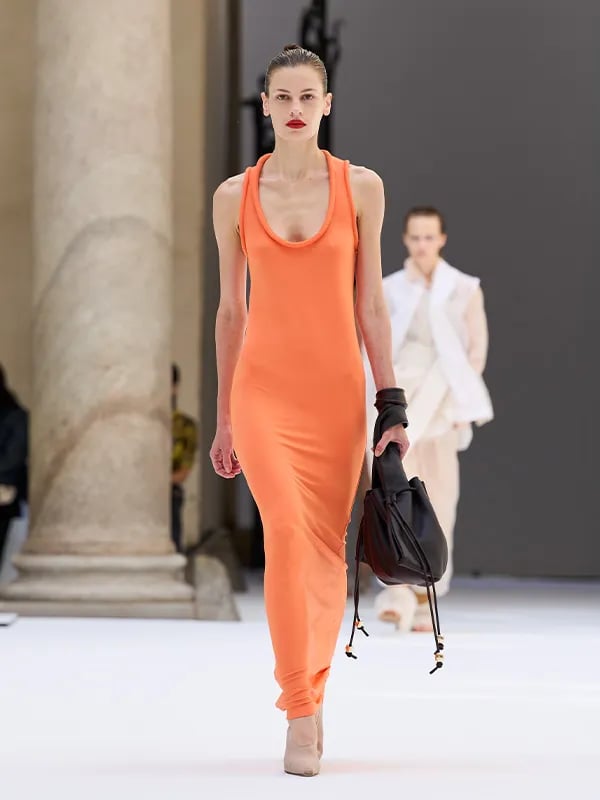
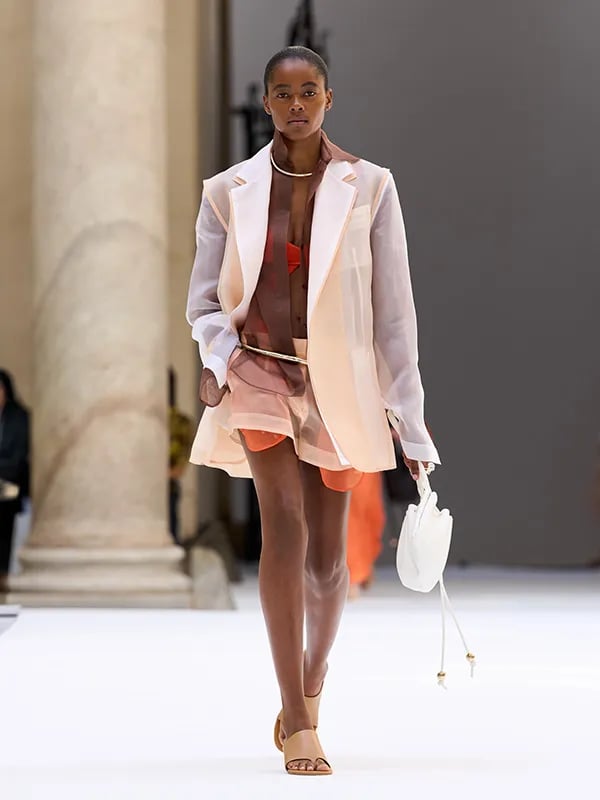
Outerwear lost its arms. Silk organza went on in écru, orange and blush pink, layered until the overlaps generated color the fabric did not have on its own.
The design team said the season’s heat waves produced a “longing for lightness,” and the show notes returned to the house’s founding premise — Sportmax arrived in 1969 to reflect its moment. That framing does real work here. The parts of this collection that engaged the temperature directly are the parts that held.
The Collection’s Central Idea
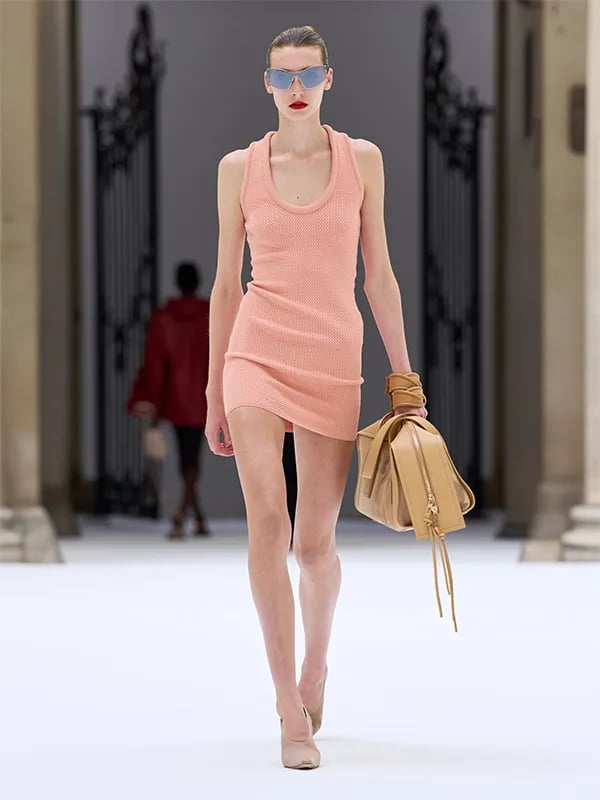
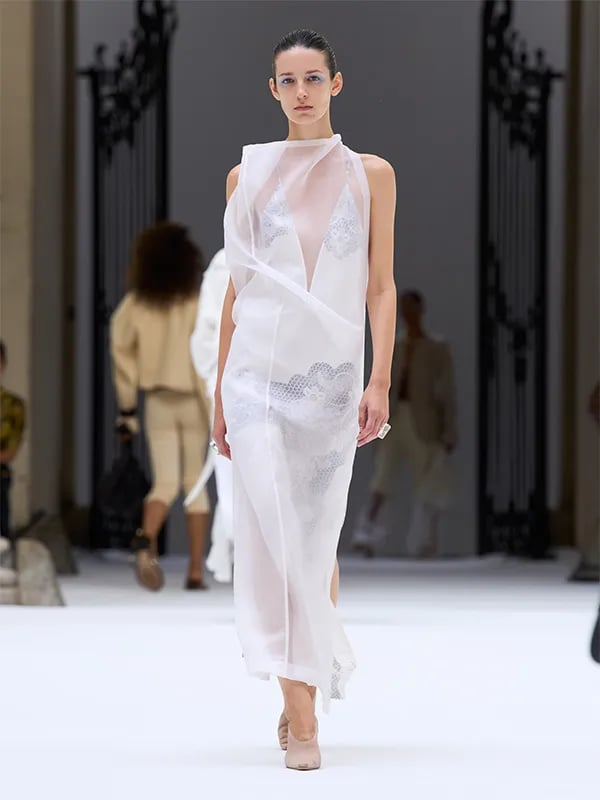
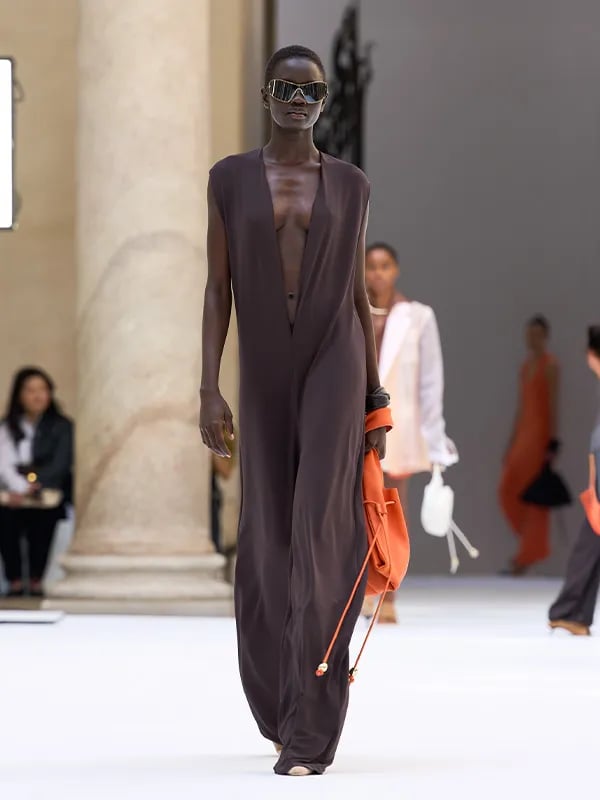
The studio’s answer to heat was structural. It removed the arm from much of the outerwear, then treated transparency as a system: organza doubled against organza, or furled as a sheath over heavier pieces such as lace-embroidered cotton slips. The proposition is that a summer wardrobe should be engineered for the temperature it will actually meet.
The collection carried both positions onto the runway at once. Long, blanket-like suede skirts and double-layer blousons with high collars arrived in a show whose stated premise was heat avoidance, while black leather took up a share of the schedule.
Silhouette and Styling
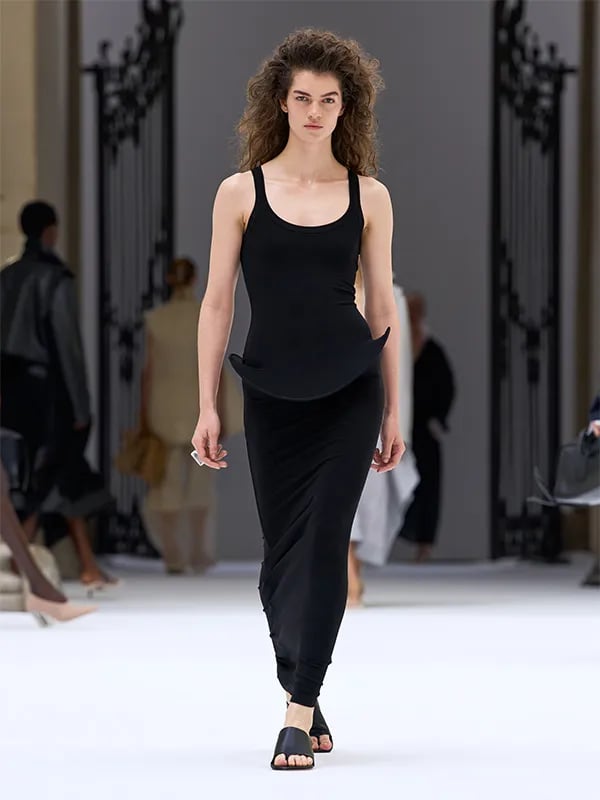
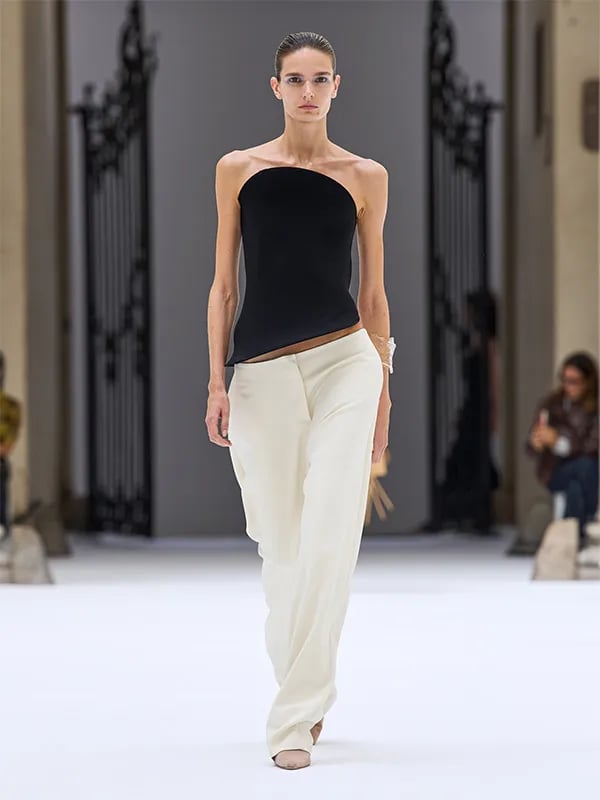
Proportion ran on contrast between a structured top and a loose bottom. Jackets sat above round, soft legs, and pinstriped trousers carried a Bermuda short hidden underneath. Trousers that ballooned at the ankle were cinched with leather clamps; bi-level skirts were cut so their tails drifted as Modelle crossed the white carpet.
Layering did most of the color work. Organza went over organza, and over heavier fabrics as a sheath, so transparency arrived as depth rather than absence. An antique Venetian lace tablecloth was translated into a print rather than reprinted as embroidery, which let the pattern ghost through the organza trench coats layered above it.
The House Codes
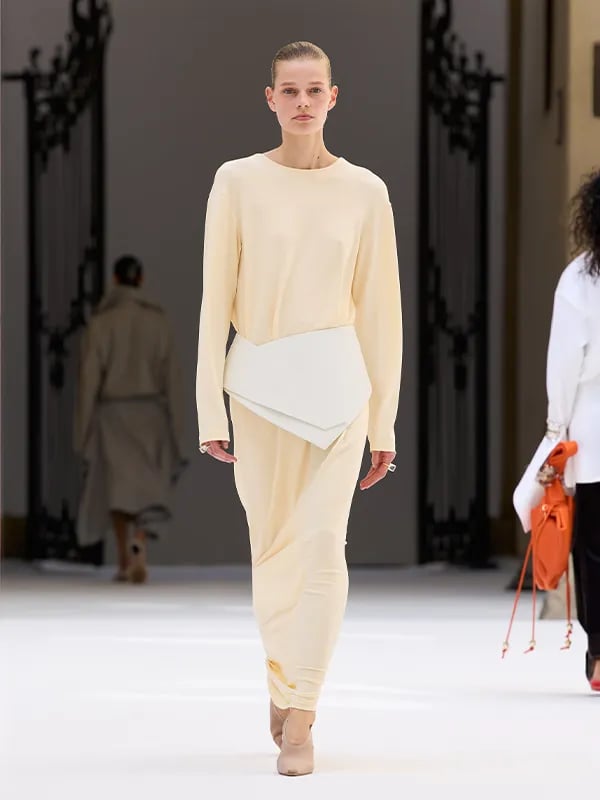
Sportmax’s vocabulary has always been tailoring held at a remove from the formal register. Here that distance went to its limit: the suit kept its construction logic and lost its weight, with voile and viscose standing in for the fabrics that normally give a jacket its shoulder.
Leather moved the other way, toward deconstruction rather than protection, with nappa and suede on a stripped-back skirt and sleeveless jackets with convertible panels built to let air through. Denim was cut closer to flou than to cloth, and trompe-l’oeil lapels were stitched flat onto the chest, a workable answer for formal dressing in a hot month.
Casting spanned generations, extending the 1969 premise to the bodies wearing it rather than only to the clothes.
What Worked
The tailoring was the most controlled element on the runway. Open panels on pinstripe voile were placed so the layer beneath completed the garment instead of revealing it, separating construction from trickery. Sleeveless outerwear is a direct answer to a hot-weather wardrobe, and the pieces kept enough shoulder structure to survive the missing arm.
Accessories stayed transparent and stayed narrow: Lucite heels and bangles, slides with contrast detail, icicle-bijou pumps, and glass set into a cuff or veiled under a liquid neckline. That is the category where a runway idea becomes a stocked item, and the studio kept it tight enough to buy.
Where It Faltered
Leather was the collection’s weakest argument, because there was a lot of it. A papyrus-toned collarless blazer over bare skin with organza pants below worked. A red leather blazer over a red leather hoodie and slim black capri pants did not — it read as a styling exercise rather than a proposition about summer.
The detailing had its own misfires. Ankle cuffing and a matching wrap at the upper wrist were the season’s strangest decisions, and the symmetry did not make them cohere. A jersey gown built around a wire protrusion reached further than the rest of the line-up with no argument behind it.
Then there is the group overlap. The organza pants that anchored several exits had already appeared on the Max Mara runway earlier in the week. Read one way, that is group research and development working as intended. Read another, two labels inside the same house are making the same bet in the same week.
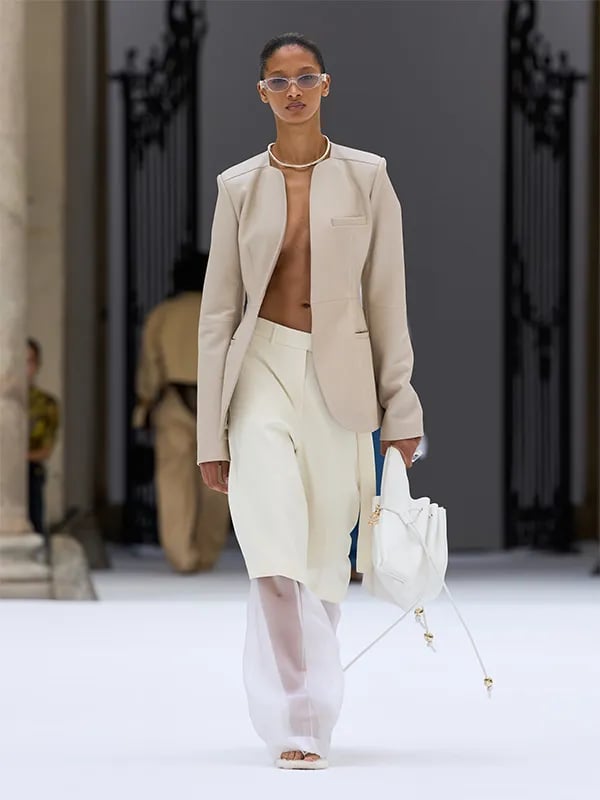
Sportmax sits inside Max Mara Fashion Group as the label that tests propositions the parent’s core business does not need to carry. A heat-driven Sommergarderobe is worth testing, because the constraint isn’t going away, and the sheer tailoring is the most transferable thing on the runway: blazers, trousers, and organza layers a customer can buy into one piece at a time.
The prices frame the strategy. Sportmax’s U.S. e-commerce currently lists trousers from $490 to $945, a band where a sheer-fabric garment has to justify itself on construction rather than novelty. That is the argument the pinstripe voile was built to make.
The leather exits will sell in another climate or another month, and carrying them here spent Landebahn time on product the collection did not need to defend. The transparent accessories, by contrast, are the line’s most repeatable idea and the one least dependent on a hot September.
Heat is the constraint Milan will be designing against for a decade. Sportmax is the label in its group built to take that brief, and its sheer tailoring is how it did it.
See the complete collection below:
Images courtesy of Sportmax
In another fashion week news, Fendi Spring 2027: Maria Grazia Chiuri Finds Freedom in Lingerie