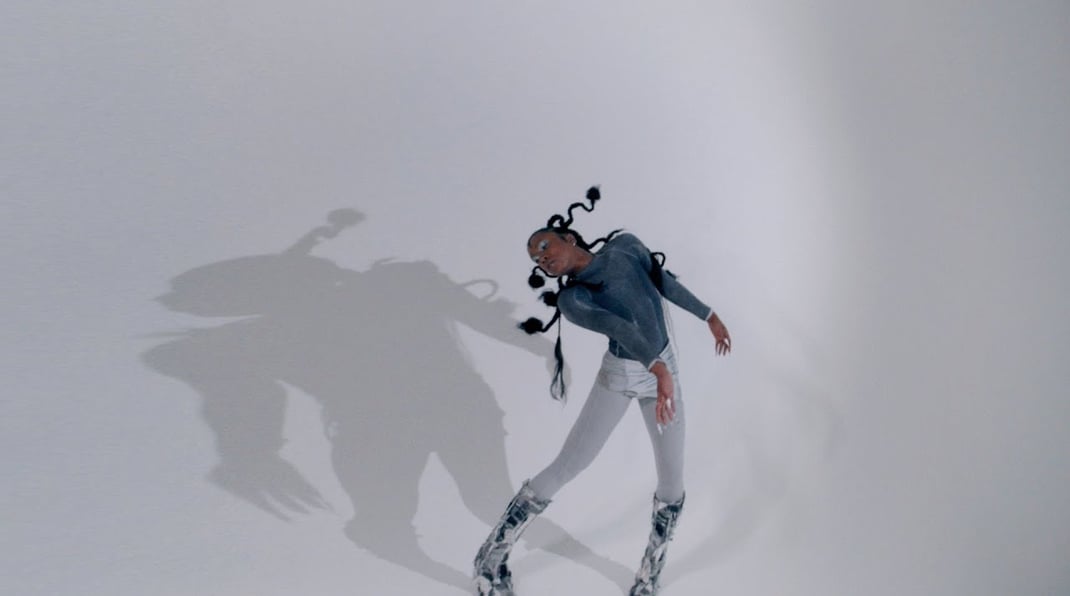

Kicking off London Fashion Week June 2021, is the Official Digital Opening, entitled ‘Everything Is Temporary’. The BFC commissioned a performance by dancer, artist, trans activist and NEW WAVE: Creative Sakeema Peng Crook. Directed by creative studio DBLG for LFW, the short film is a meditation on the rebirth of British fashion and cultural arts and explored the re-emergence of the creative arts as part of the cultural re-opening of London following the disruptions of the pandemic era.
The film features a captivating performance from Sakeema, styled by fellow NEW WAVE: Creative artist Betsy Johnson. The statement piece supports emerging talent from the UK inspired by finding freedom in nature and dreaming of a new future.
Subscribe to the British Fashion Council ►►
British Fashion Council Website: http://www.britishfashioncouncil.co.uk/
British Fashion Council Facebook: https://www.facebook.com/britishfashioncouncil/
British Fashion Council Twitter: https://twitter.com/BFC
British Fashion Council Instagram: https://www.instagram.com/britishfashioncouncil/
Looking back from 2026, the film stands as a landmark document of how the British Fashion Council used digital storytelling to sustain global audience engagement during one of fashion's most transformative periods.
The Context Behind the Commission: British Fashion in a Post-Pandemic Moment
London Fashion Week June 2021 arrived at a pivotal inflection point for the British fashion industry. After more than a year of closures, cancelled shows, and compressed supply chains, the British Fashion Council made a deliberate choice to open the event not with a commercial runway presentation, but with an act of cultural reflection. The commission of ‘Everything Is Temporary’ signaled that recovery, for British fashion, would be rooted in creative identity rather than commercial spectacle alone.
The BFC had spent the pandemic period accelerating its digital infrastructure, and by June 2021, its platform had reached audiences across more than 150 countries. The decision to lead with a meditative short film rather than a traditional show opener was therefore both artistic and strategic. It acknowledged that the industry’s global audience had expanded precisely because digital formats removed the geographic barriers that had historically kept fashion week exclusive to press, buyers, and industry insiders.
The theme of temporality also carried direct resonance for a sector that had been forced to confront its own unsustainable rhythms. Questions around the pace of the fashion calendar, the volume of collections, and the environmental cost of the industry had intensified throughout 2020 and 2021, giving the film’s central idea a dimension that extended well beyond personal experience.
Sakeema Peng Crook and the NEW WAVE: Creatives Program
Central to the film’s impact is the performance of Sakeema Peng Crook, whose presence brings together multiple layers of meaning. As a dancer, artist, and trans activist, Crook represents a generation of British creatives whose work operates across disciplines and communities simultaneously. The BFC’s decision to place her at the center of the opening film was a clear statement about whose voices the institution intended to amplify as British fashion moved into its next chapter.
The NEW WAVE: Creatives initiative, through which both Crook and stylist Betsy Johnson were identified, is a BFC program designed to surface and support emerging talent from across the United Kingdom. It functions as a talent pipeline that connects young practitioners with industry platforms, mentorship, and visibility that would otherwise require years of industry networking to access. The initiative deliberately casts a wide net across disciplines, including styling, performance, film, and visual art, reflecting the BFC’s recognition that contemporary fashion creativity is rarely contained within a single medium.
Betsy Johnson’s styling work on the film deserves specific recognition. The choices made in constructing Crook’s look served the film’s themes directly, using garment and silhouette to communicate ideas about freedom, transformation, and emergence that reinforced rather than decorated the film’s central narrative.
Digital Storytelling as the New Language of London Fashion Week
The collaboration between the BFC and creative studio DBLG to produce ‘Everything Is Temporary’ reflects a broader shift in how major fashion institutions communicate their values to a global audience. DBLG brought a visual language to the project that was cinematic in its ambition while remaining intimate in its scale, qualities that translate with particular effectiveness across the digital platforms through which most of the film’s audience encountered it.
Looking back from 2026, the film stands as a landmark document of how the British Fashion Council used digital storytelling to sustain global audience engagement during one of fashion’s most transformative periods. The format demonstrated that a short film anchored in performance, styling, and a clearly articulated concept could carry as much cultural weight as a traditional runway show, and in some respects more, because it spoke directly to audiences rather than primarily to the room.
For international audiences, including the global readership that follows British fashion from New York, Tokyo, Paris, and beyond, the digital-first approach removed friction from the experience entirely. The film could be watched, shared, and discussed across time zones without loss of quality or context. This accessibility was not incidental but foundational to the BFC’s strategy, and ‘Everything Is Temporary’ exemplifies what that strategy produced at its most considered and compelling.