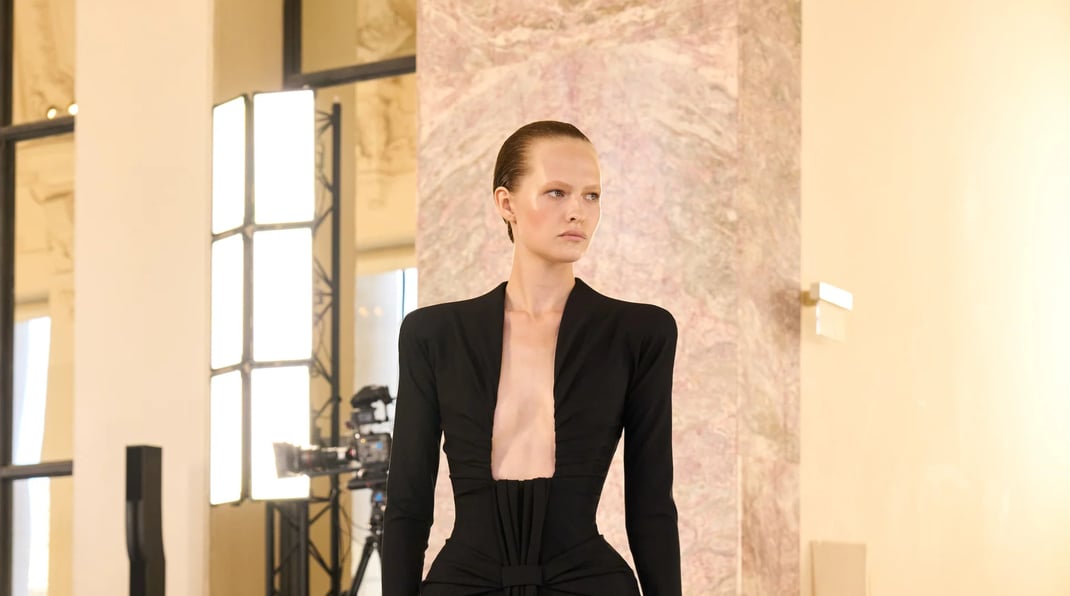

Daniel Roseberry opened Paris Couture Week for Schiaparelli Fall 2026 with a collection that pits handcraft against the digital age. Working with a Paris workshop that makes photorealistic silicone babies for film, he produced latex jackets with inflatable tentacles, molded silicone bustiers, gowns that pulsed with light, and a putty pink pearl-embroidered prom dress worn by Amelia Gray. The color palette drew from Matthew Barney’s “Cremaster Cycle.” Roseberry, who still sketches every look, described the collection as a “collision” between digital and hand processes — and positioned it as a playground for Schiaparelli’s clients.

- Daniel Roseberry opened Paris Couture Week for Schiaparelli Fall 2026 with a collection built from latex, molded silicone, dried flowers, seashells, and fish scales — materials sourced in part from a Paris workshop that produces photorealistic silicone babies for the film industry.
- The color palette was drawn from Matthew Barney’s “Cremaster Cycle,” and specific looks included a latex jacket with inflatable tentacles, gowns that pulsed with light, and a putty pink pearl-embroidered prom dress worn by Amelia Gray.
- Roseberry, who still sketches every look by hand, framed the collection as a direct response to AI’s encroachment on design education and creative authorship — describing it as a “collision” between digital and handcraft processes.
The Schiaparelli faithful arrived at 10 a.m. in full gilded anatomic regalia. That detail alone tells you something about the house’s relationship with its audience: these are not passive observers. They dress for the occasion with the same commitment the atelier brings to the runway, and on this particular morning in Paris, the occasion was Daniel Roseberry opening Couture Week with a collection that had something urgent to say.
The subject was authorship. Specifically, who holds it when algorithms can generate a portfolio in an afternoon. Roseberry had recently visited a university and found AI throughout the senior projects, a discovery he described as disorienting. He is, by his own account, a purist — one of the last designers who sketches every look. That context matters here. It shapes every material choice, every gelatinous surface, every deliberately strange silhouette in the 30-look lineup.
Couture, he argued, is where the hand still wins.


How Roseberry Built a Collection From Latex, Silicone, and the Vocabulary of Body Horror
The materials are the argument. Roseberry worked with a Paris workshop that specializes in photorealistic silicone babies for the film industry, and the collaboration produced results that sit at the precise border between craft and unease. Molded silicone bustiers had a jelly-like quality. Gowns pulsed with embedded light. A latex jacket arrived fitted with inflatable tentacles. Flesh-colored silicone back gills appeared on at least one look, a detail that registered as both anatomical and architectural.
The color palette came from Matthew Barney’s “Cremaster Cycle,” a reference that clearly signals intent: this is not beauty for comfort’s sake. Glossy molded jackets and corsets carried the same pneumatic stiffness as the Allen Jones breastplate Kim Kardashian wore to the Met Gala. Rubbery dresses clung and quivered. Against all of that, the putty-pink pearl-embroidered prom dress on Amelia Gray read as the collection’s most pointed contrast — prettiness with a faint menace beneath. Dried flowers, seashells, and fish scales completed the material inventory, each one a handmade counter-argument to the rendered image.


Why Schiaparelli’s Surrealist Inheritance Makes This the Right House for the AI Debate
Roseberry traced his approach directly to Elsa Schiaparelli and the Surrealists, and the lineage holds. The original house produced mind-bending imagery without an algorithm, a point the “Schiaparelli: Fashion Becomes Art” exhibition at the Victoria & Albert Museum in London makes with considerable force right now. Roseberry is working in that tradition, but he is also updating it for a specific cultural anxiety: the fear that the hand is becoming optional.


His clients, he said, treat the runway as a playground and a mood board rather than a literal directive. That framing is important. It positions the collection’s extremity as an invitation rather than a provocation, a set of possibilities for women who already understand the house’s codes. The audience in gilded anatomic regalia understood exactly what they were watching. Extreme shapes, gelatinous textures, and freaky mutations are not departures for Schiaparelli — they are the point of entry.


Roseberry’s Fall 2026 couture collection is the most coherent argument he has made for why the hand still matters, and he makes it without a single concession to accessibility. The materials are confrontational, the references are precise, and the construction — developed with a film-industry workshop and executed in haute couture techniques — is genuinely without precedent on the Paris calendar. This is a designer who knows exactly what he is doing and why. The collection does not ask for approval.
See the collections below:
Images Courtesy of Schiaparelli
In other brand campaign news, Marc Jacobs Spring 2027 Ready-to-Wear Collection