Aspects in Astrology
Learn how conjunctions, oppositions, trines, squares and sextiles describe relationships between planets in a birth chart.
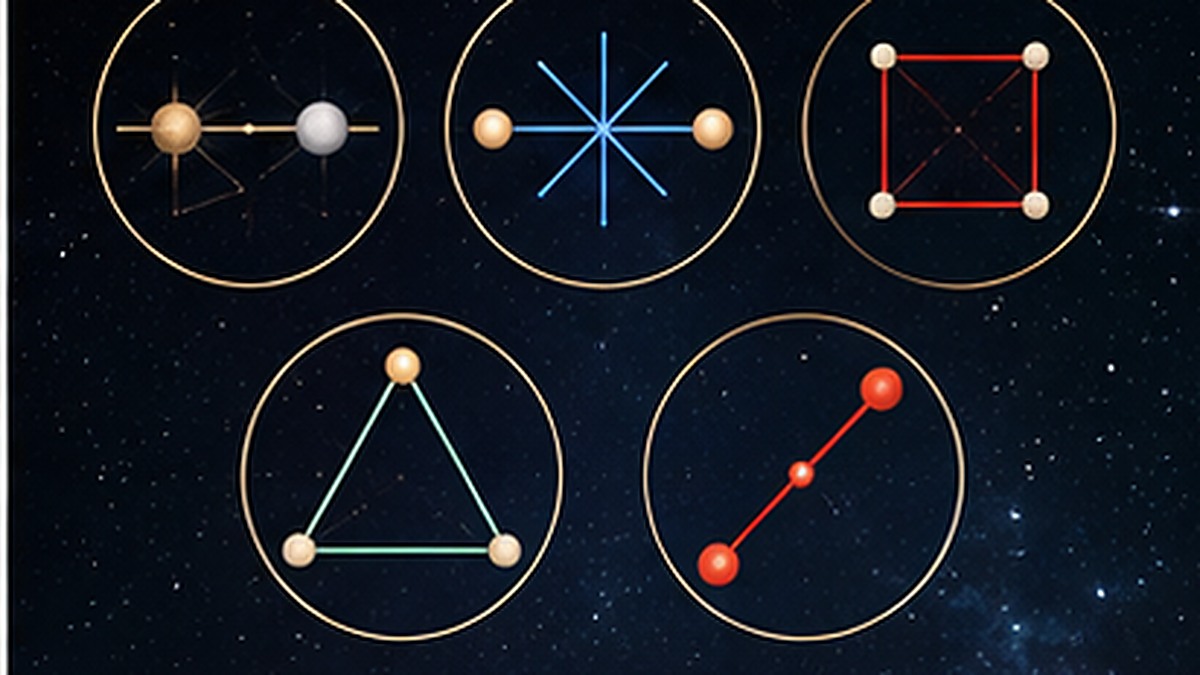
Aspects are angular relationships between planets or chart points. Major aspects such as conjunctions, oppositions, trines, squares and sextiles are used to describe how two chart functions interact. The closer an aspect is to its exact angle, the tighter its orb.
Why aspects matter
A planet can be understood by sign and house, but aspects reveal how it participates in the rest of the chart. They can connect otherwise separate themes and explain why a placement feels easy in one context and more demanding in another.
Aspects are relational rather than isolated. A Venus placement, for example, takes on additional meaning when closely connected with Saturn, Mars or Neptune.
Conjunctions and oppositions
A conjunction occurs when two chart factors occupy roughly the same zodiac degree. Their functions are interpreted as strongly combined or concentrated, though the result depends on the planets involved.
An opposition places planets across the chart from one another. It is often interpreted through polarity, awareness, projection, balance or the need to integrate two competing ends of an axis.
Squares, trines and sextiles
A square is a roughly ninety-degree relationship and is commonly associated with friction, pressure, effort and development. It can describe a problem that demands engagement rather than a simple negative event.
A trine is roughly 120 degrees and is associated with flow or compatibility between functions. A sextile is roughly sixty degrees and is often interpreted as an opportunity or cooperative connection that benefits from participation.
What an orb is
An aspect does not have to be exact to be used. The acceptable distance from the exact angle is called the orb, and astrologers use different orb ranges depending on the planets, aspect and interpretive school.
Tighter aspects are generally treated as more concentrated. Wider aspects can still be used, especially when the Sun or Moon is involved, but consistency in orb rules helps prevent overreading a chart.
Avoiding good-versus-bad aspect labels
Trines and sextiles are often called harmonious, while squares and oppositions are often called challenging. That shorthand can be useful, but it can also oversimplify.
Easy aspects can describe talents that are taken for granted, and difficult aspects can become sources of strength through repeated engagement. The whole chart determines how an aspect is experienced.
Major aspects
Frequently Asked Questions
What is the strongest aspect in astrology?
There is no single strongest aspect in every chart. Conjunctions are highly concentrated, but strength also depends on orb, planets, angles and the rest of the chart.
Are squares always bad?
No. Squares are usually interpreted as friction or pressure, but they can also describe motivation, skill developed through effort and areas of significant growth.
What does a tight orb mean?
A tight orb means two chart factors are close to the exact angle of an aspect. Many astrologers give tighter aspects more interpretive weight.
Explore NYSG Astrology
Use the reference library as the foundation, then move into current readings and the broader NYSG astrology experience.
Read current Daily, Weekly, Love, Money, Career and Wellness forecasts.
Explore →Zodiac Sign GuidesExplore the enduring traits, style and structure of all 12 signs.
Explore →Compatibility LabMove from reference concepts into relationship-focused sign pairings.
Explore →Celebrity ZodiacSee how zodiac-sign content connects with designers and cultural figures.
Explore →