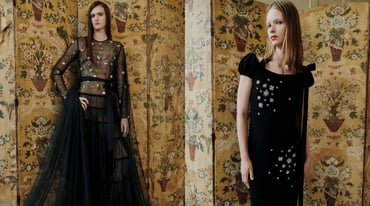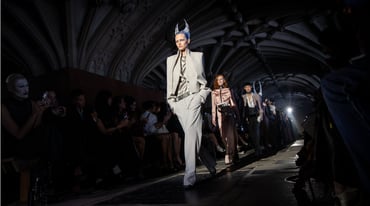
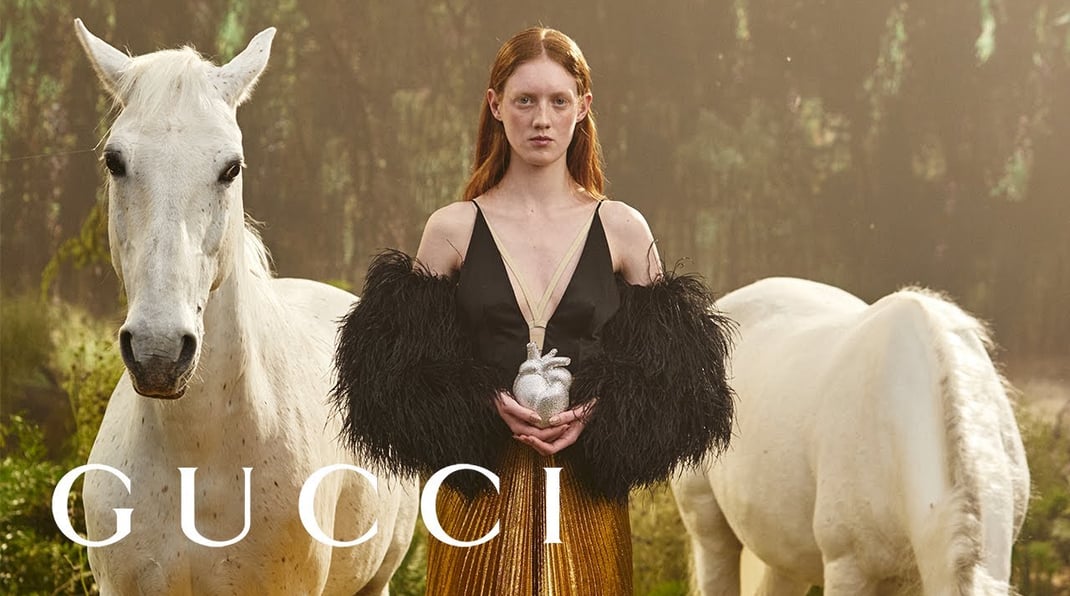

Debuting in a special film co-directed by award-winning photographer and director Floria Sigismondi and then-Creative Director Alessandro Michele, Aria. A singular voice, taking its turn in the spotlight; in the Italian language, ‘air’. In his notes on the collection, Alessandro Michele called it “a deep and ecstatic diving in everything we yearningly miss today… a jubilee of breath.”
In the year of Gucci’s centenary, Alessandro Michele opened the locks of history, only to find a deeply personal vision of the mythology that surrounds the brand. Standing sentinel is the Savoy Club, a tribute to The Savoy Hotel in London where founder Guccio Gucci worked as a liftboy in his youth.
Once inside, Aria’s “hacking lab made of incursions and metamorphoses”, from Alessandro Michele’s notes on the show, is unveiled, featuring elements from House heritage and designs from Demna Gvasalia, Creative Director of Balenciaga, ultimately expressions of reverence and homage.
#구찌아리아 #A리스안드로미셸
음악:
알레산드로 미켈레가 작곡하고 로렌스 로스만이 믹싱한 이 사운드트랙은 구찌라는 단어가 등장하는 노래들로 구성되어 있으며, 구찌의 지속적인 힘과 대중문화의 어휘에 얼마나 많은 기여를 했는지에 대해 이야기합니다.
릴 펌프 "구찌 갱"
(B. 머레이/G. 가르시아/G. 닐리)
저작권 © 코발트 뮤직 퍼블리싱 주식회사 오보 사이파크 송스, 에스킷잇 퍼블리싱, 사이프레스 파크 뮤직, 타 라이츠 글로벌 퍼블리싱 LLC
(P) 2017 Tha Lights Global/Warner Records Inc. / 워너 뮤직 이탈리아 Srl
릭 로스 위업. 미래의 "그린 구찌 수트"
(R. 로스/A. 스튜어트/N. 윌번/D. 헤이즈)
© 2018 Universal, Dick James Music Ltd. Irving Music, Inc. 나이바디우스 막시무스 뮤직, EMI 블랙우드 뮤직, 4 블런트 라이트 앳 원타임 퍼블리싱
유니버설 뮤직 퍼블리싱 리코디 주식회사, EMI 뮤직 퍼블리싱 이탈리아에서 라이선스 제공
(P) 2018 에픽 레코드, 소니 뮤직 엔터테인먼트, 워너 뮤직 이탈리아 Srl
바드 바비 "구찌 플립플랍 (feat. 릴 얏티)"
(M. McCollum / L. Jae / I. Whitlow / J. Muhammad / L. Porter / D. McCorkell / D. Bregoli / S. Gloade / J. Lowe)
© 2018 Ten Down Muzik, Eardrummers Entertainment LLC, Samuel Gloade의 출판 지정자, Warner-Tamerlane Publishing Corp., Artist Publishing Group LLC, Songs Of Universal, Inc., Boat Boy's Publishing, BMG Platinum Songs US, Mushie Music, Built By Music, Josiah Muhammad Publishing, Bhabie Publishing
라이선스: Warner Music Publishing Italy S.r.l., 코발트 뮤직 퍼블리싱(주), 유니버설 뮤직 퍼블리싱 리코르디(주), BMG 권리 관리(이탈리아) srl, 관리 MP 주식회사, 카페 콘체르토(주)
(P) 2018 아티스트 파트너 그룹 주식회사, 워너 뮤직 이탈리아 Srl
미에르 "구찌 온 마이 백"
© (P) 젠덱스 레코드
다이 앤트워드, 디타 폰 티즈 "구찌 쿠치"
(A. Du Toit / W. Jones / J. Nobrega / L. Muggard / Dita Von Teese)
© 2016 제프 퍼블리싱, 코발트 뮤직 퍼블리싱, 유니버설 뮤직. Corp.
Warner Music Publishing Italy S.r.l., Universal Music Publishing Ricordi Srl.
℗ Zef Records LLC / AWAL Recordings Ltd
비탈릭, feat. 데이비드 쇼와 더 비트 "별을 기다리며"
(P. Arbez / D. Shaw / J. Garraud)
© 2017 다운타운 뮤직, 스퀘어 리볼리 퍼블리싱, 버드 뮤직 프랑스, 엄격하게 기밀 유지 프랑스, CTZ 퍼블리싱
Dipiu', Accordo Edizioni Srl에서 라이선스 제공 이 비디오의 제작은 보건 및 안전 지침과 Covid 관련 법률 및 규정을 따랐습니다.
뷰로 베리타스 이탈리아는 동물이 있는 세트장을 모니터링하여 동물이 다치지 않았는지 확인했습니다.
The Aria collection has taken on renewed cultural weight in 2026, as Gucci navigates a new creative era under Demna, prompting fashion historians and critics to revisit Michele's tenure as a defining chapter in the House's second century.
The Balenciaga Collaboration: A Historic Hacking
Among the most discussed elements of Gucci Aria was the unprecedented creative dialogue between Alessandro Michele and Demna Gvasalia, then Creative Director of Balenciaga. Rather than a conventional collaboration, Michele framed the exchange as a ‘hacking,’ a term he used deliberately to evoke the unauthorized yet celebratory borrowing of codes between two of fashion’s most architecturally distinct houses.
The result was a collection of pieces that merged Gucci’s florid romanticism with Balenciaga’s austere, sculptural sensibility. Iconic Balenciaga silhouettes were reinterpreted in Gucci fabrics and adorned with the interlocking GG monogram, while Gucci archival forms absorbed the structured geometry associated with Gvasalia’s hand. Handbags, tailoring, and footwear all bore the dual imprint of both creative visions simultaneously.
Fashion critics noted that the hacking concept challenged long-standing assumptions about brand identity, intellectual ownership, and the nature of influence within luxury fashion. Rather than diluting either house, the exchange underscored how deeply the vocabularies of both designers had already shaped one another over years of parallel cultural dominance. Aria positioned this mutual admiration as a form of tribute, honest and transparent in a way that the industry had rarely seen at this scale.
Gucci Aria and the Language of Centennial Identity
Gucci Aria arrived in April 2021, marking one hundred years since Guccio Gucci founded his leather goods house in Florence in 1921. Rather than staging a conventional retrospective, Michele used the centenary as a provocation, asking what memory, mythology, and institutional longing actually look like when translated into garments worn by living bodies.
The collection drew on a vast archive: the bamboo handle bag, the horsebit loafer, the House’s equestrian heritage, and the silk scarves that have defined Gucci’s visual language across decades. Each reference was layered rather than quoted directly, filtered through Michele’s signature lens of maximalism, literary allusion, and gender fluidity.
The Savoy Club set design anchored this temporal complexity with physical specificity. The choice of The Savoy Hotel in London as the conceptual starting point grounded the centennial narrative in something intimate and biographical. Guccio Gucci’s time as a young immigrant working in one of the world’s most storied luxury hotels is widely credited with shaping his understanding of craftsmanship, aspiration, and the objects that signal refinement. Michele’s decision to open the collection there was not nostalgic; it was archaeological, insisting that origin stories carry living weight.
Cultural Resonance and the Gucci Aria Soundtrack
The soundtrack assembled for Gucci Aria deserves consideration as a curatorial statement in its own right. Alessandro Michele and Lawrence Rothman compiled tracks from across a decade of popular music, each one featuring the word ‘Gucci’ as a signifier of aspiration, status, or cultural fluency. The selection spans trap, hip-hop, electro, and alternative pop, encompassing artists including Lil Pump, Rick Ross, Bhad Bhabie, Die Antwoord, and Vitalic.
The editorial logic behind this choice was precise. By scoring a centennial fashion film with music in which independent artists spontaneously invoked the Gucci name, Michele made an argument about cultural longevity that no press release could replicate. The House had, over its hundred years, entered the vernacular of global popular culture so completely that its name functioned as both noun and adjective, as aspiration made audible.
This approach also reflected Michele’s broader philosophy during his tenure, a commitment to treating fashion as a conversation across disciplines, generations, and subcultures rather than as a top-down pronouncement from a singular creative authority. The soundtrack did not merely accompany the collection; it contextualised it within a century of cultural production, demonstrating that the House’s influence had long since exceeded the boundaries of the runway.