
Jonathan Anderson’s second haute couture collection for Dior, shown at a wooden pavilion in the gardens of the Rodin Museum on July 6, 2026, translated the sculptural practice of American artist Lynda Benglis into garments constructed from silver lamé, copper lamé, micro-plissé organza, hand-pleated chiffon, and fragments of 18th-century Indian chintz, with the Bar jacket reappearing in fern green tweed and TV static gray, and the show arriving three days after Anderson dressed both Taylor Swift and Travis Kelce in custom Dior for their wedding at Madison Square Garden.
- Jonathan Anderson’s second haute couture collection for Dior, presented on July 6, 2026, in a wooden pavilion built in the gardens of the Rodin Museum, translated the sculptural experiments of American artist Lynda Benglis into garments constructed from silver lamé, copper lamé, micro-plissé organza, metallic satins, hand-pleated chiffon, and fragments of 18th-century Indian chintz.
- The collection arrived three days after Anderson dressed both Taylor Swift and Travis Kelce in custom Dior haute couture for their wedding at Madison Square Garden, a commission that generated $15 million in media impact value over the July Fourth weekend according to Launchmetrics.
- Key pieces included a silver lamé dress draped into a bow derived from Benglis’s pleated metallic “Goliath” sculpture, abstract skirts of silver netting patched with metallic fabric and chiffon inspired by her chicken wire works, the 1948 Arizona trapeze coat given a pleating treatment, Bar jacket variants in fern green tweed and TV static gray, and a finale wedding dress of strapless pearl column veiled in hand-pleated chiffon with white feather dandelions and embroidered cactus flowers.
Three days before this show, Jonathan Anderson made a wedding dress. The client was Taylor Swift. The venue was Madison Square Garden. The resulting coverage generated $15 million in media impact value for Dior over the July Fourth weekend, according to Launchmetrics. On the morning of his sophomore couture presentation, Anderson would say only that it was “a big honor” and “a joy to work with her. We became very good friends. It’s an emotional thing doing someone’s wedding.”
Then he changed the subject entirely. The fall couture collection, staged inside a wooden pavilion constructed in the gardens of the Rodin Museum, drew not from bridal sentiment but from the sculptural practice of Lynda Benglis, the American artist whose experiments with beeswax, latex, porcelain, and fans provided the conceptual framework for every garment on the runway. Anderson had previously worked with Benglis at Loewe, commissioning a jewelry collection, a campaign appearance, and featuring her metal sculptures on that house’s landasan pacu. At Dior, the collaboration deepened: Benglis contributed several bags shown in the collection, and her formal vocabulary was translated directly into the clothes.


How Silver Lamé, the 1948 Arizona Coat, and a Holographic Artforum Reference Build Anderson’s Most Literal Artist-to-Garment Translation
The translation was, at points, remarkably direct. Benglis’s pleated metallic “Goliath” sculpture became a silver lamé dress draped into a bow. A series of her colorful paper-and-chicken-wire constructions inspired abstract skirts assembled from silver netting, patched with metallic fabric and layered with chiffon. Her 1974 Artforum self-portrait, in which she appeared naked wearing white sunglasses and holding an oversize dildo, was rendered as a holographic outline on a beaded look Anderson titled “Mirage.” The image was blurred to avoid offending potential clients.
The collection also opened a dialogue between Benglis and the Dior archive. Christian Dior’s scarlet Arizona trapeze coat from 1948 received a pleating treatment that connected the founder’s structural instincts to the sculptor’s material ones. The Bar jacket appeared in multiple iterations: a fringed version in fern-green tweed and a speckled variant in TV-static gray that dissolved into a vaporous white chiffon hem. Both registered as the collection’s clearest points of contact with the house’s architectural identity.


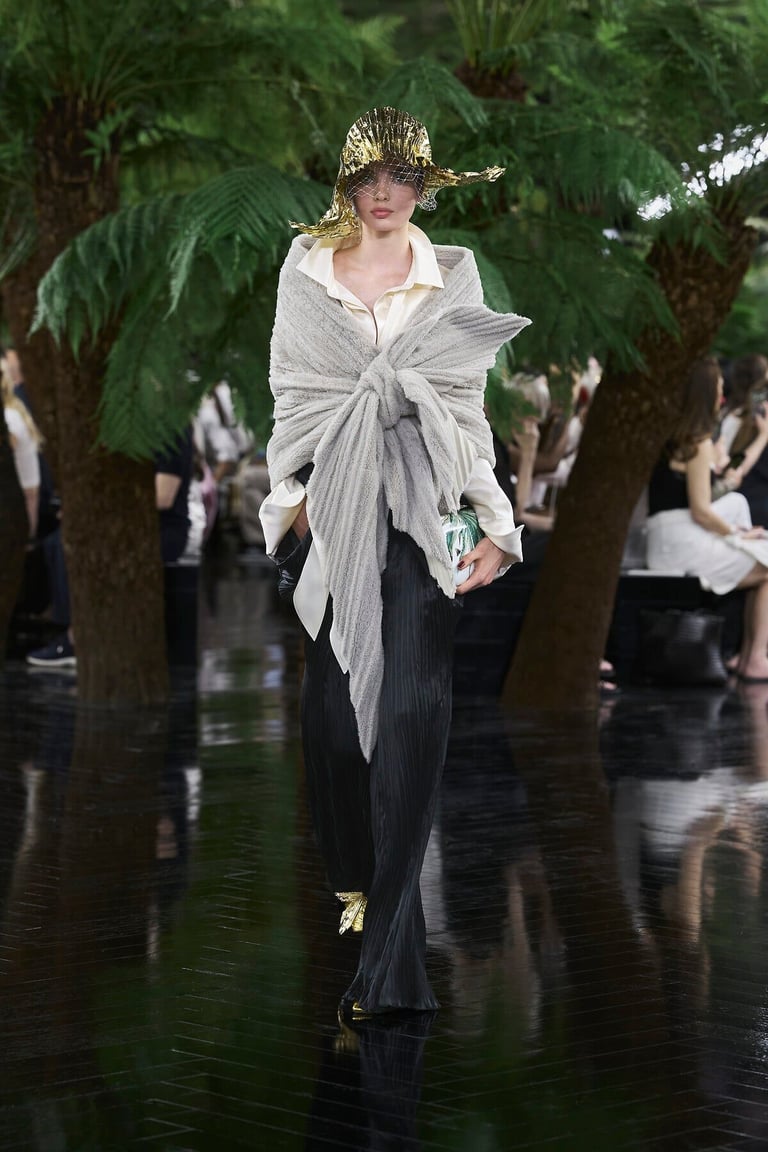
Materials ranged from metallic satins and copper lamé to micro-plissé organza, sequins, shearling strips, denim flowers, and embroidered flora. Evening bags were crafted from fragments of 18th-century Indian chintz, a reference to Benglis’s relationship with Ahmedabad and the historical exchange between Indian decorative traditions and European mode. The first look set the register: a floppy satin shirt with black plissé trousers, an oversized shearling shawl, and an acorn-shaped bonnet. A cowl-backed peach silk evening gown and a sculpted hourglass jacket in silk jacquard embossed with silk ferns provided the collection’s most direct expressions of glamour.


Why Anderson’s Cerebral Pivot After the Swift Commission Raises the Central Question of His Dior Tenure
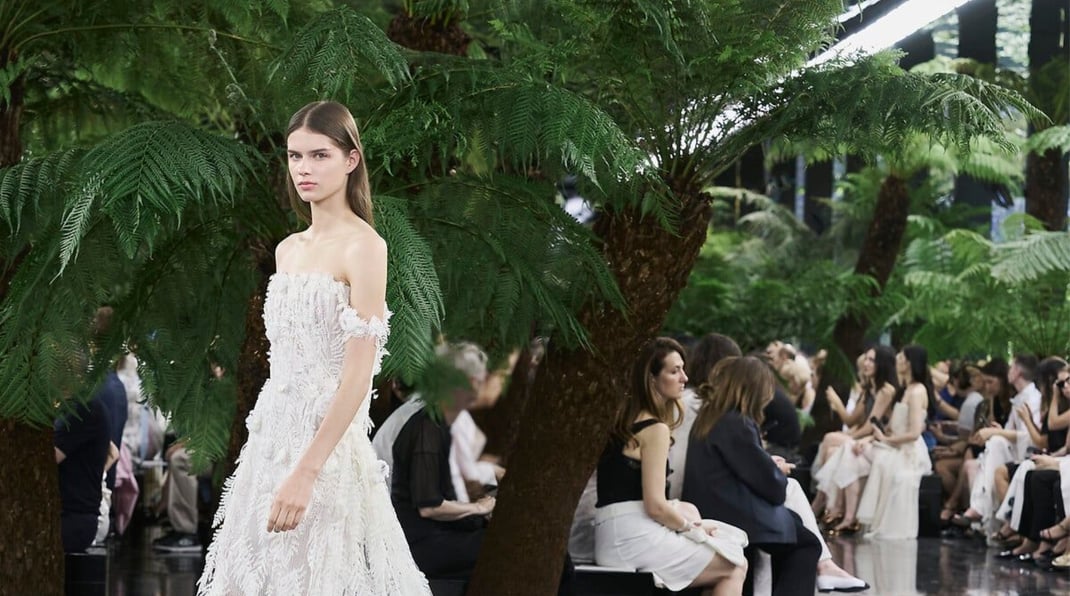
The finale was a wedding dress, as is traditional in couture. A strapless pearl column arrived veiled in a canopy of hand-pleated chiffon embellished with white feather dandelions and embroidered cactus flowers. It was not the Dior wedding dress the audience wanted to see.
Anderson’s debut couture collection in January celebrated the work of ceramicist Magdalene Odundo, continuing his predecessor, Maria Grazia Chiuri, in her practice of centering female artists within the Dior world. This second outing pushed further into cerebral territory, accompanied by a throbbing ambient soundtrack that reinforced the collection’s intellectual weight. Sabrina Carpenter sat in the front row in an ivory lace cocktail dress alongside Josh O’Connor in a deconstructed sheer blazer and sequined cravat. Priyanka Chopra Jonas, Ruth Negga, and Naomi Watts were also present.


Anderson described Benglis in direct terms: “She’s a genius, and I think there’s something about how she looks at form where it nearly becomes, in a way, muscular. She was well before anyone’s time, and it’s only in the last 10 years that people have started to realize what she had done.” The Barbican Centre in London recently exhibited her work alongside Alberto Giacometti’s sculptures, but Anderson’s engagement with her practice predates that institutional recognition.


Anderson’s second couture collection for Dior is the work of a designer who has chosen intellectual ambition over commercial momentum at the precise moment when the Swift commission handed him the largest audience of his career. The Benglis translations are specific, the archive references are grounded, and the material range across lamé, chintz, organza, and hand-pleated chiffon demonstrates atelier-level execution. Whether the cerebral register can sustain the emotional clarity that couture clients require remains the open question of his tenure. The craft is visible. The research is evident. The next collection needs to make the audience feel what Anderson already knows.
See the collections below:
Images Courtesy of Dior
In another couture collection news, Schiaparelli Fall 2026 Couture Collection at Paris Fashion Week