

CAIRO DIARY: Casablanca is continuing its season-long residency in Egypt, but the story is changing register
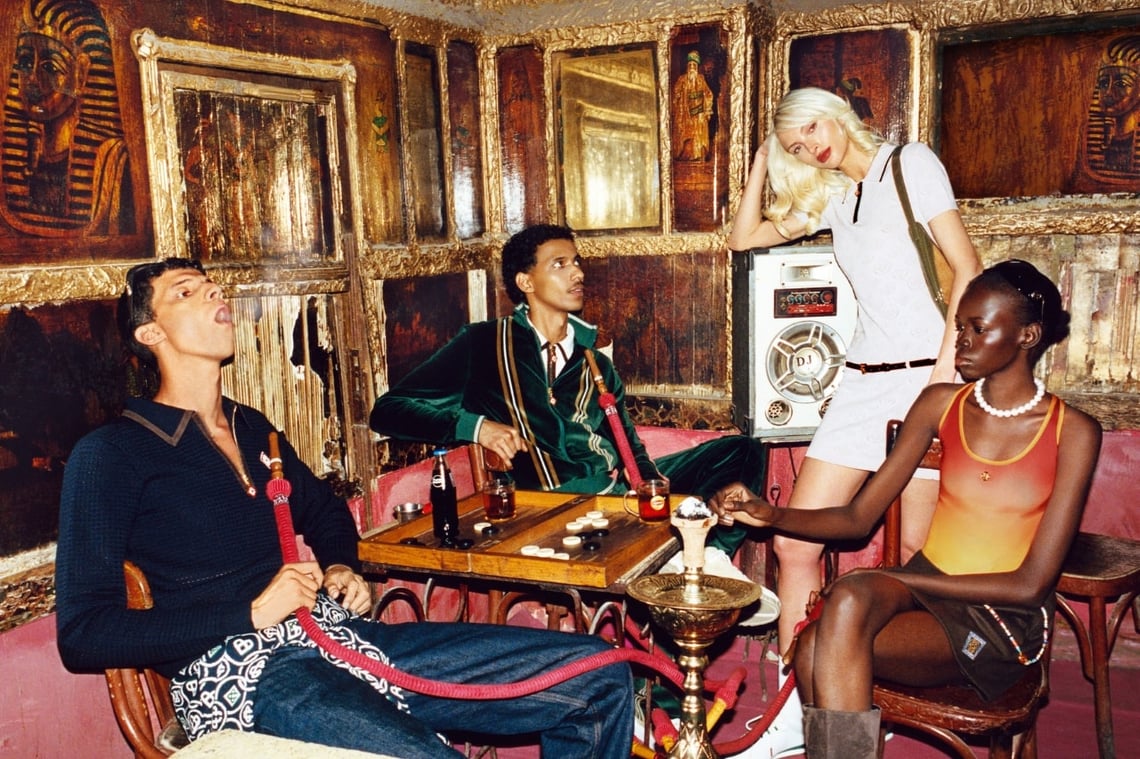
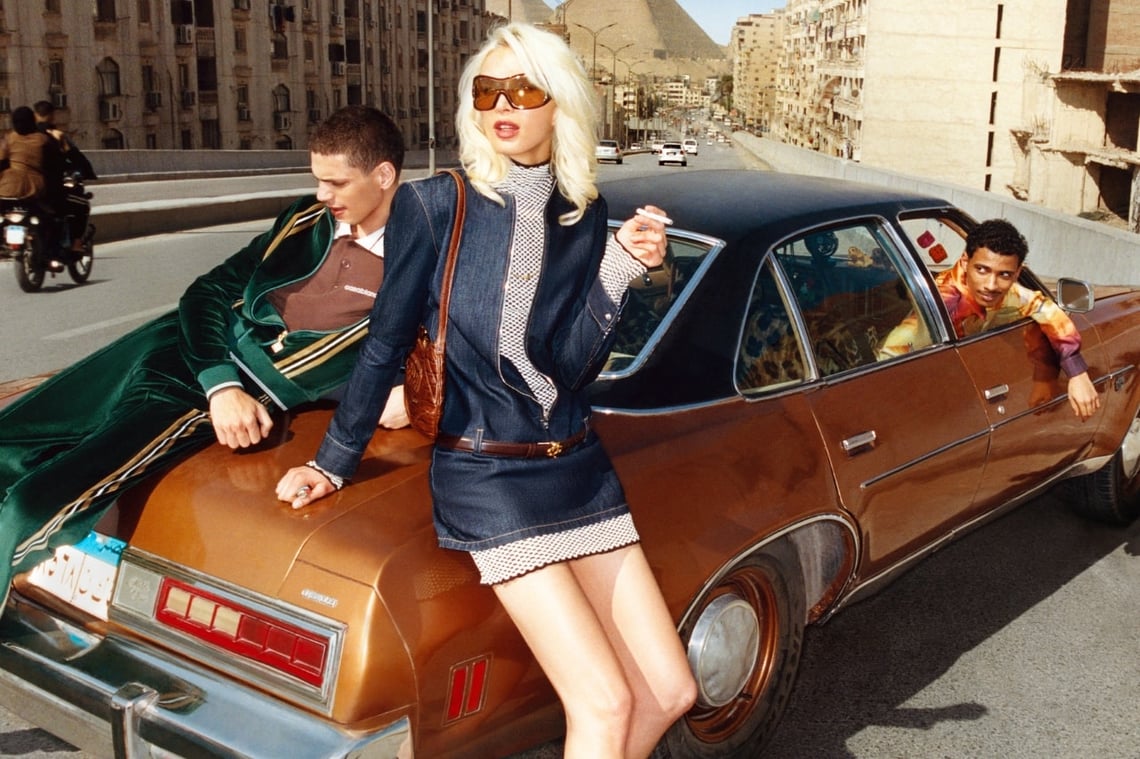
For its Autumn-Winter 2026 campaign, titled “Carnet de Voyage,” the Paris label shot on location in Cairo with photographer Theo Liu, moving the brand’s ongoing Egypt narrative away from the virtual-production fantasy of its Pre-Fall 2026 campaign and into something closer to street photography. Casablanca said the collection is “a visual diary of Cairo through the eyes of a young traveler,” built around candid moments — shared meals, chance encounters, café mornings — set against the city’s landmarks, rather than the constructed dunescapes and studio skies that carried the brand’s prior chapter.


That prior chapter, shot by Per Appelgren using virtual-production technology and framed around mythology, cosmology, and cinematic references to “Death on the Nile” and “The Prince of Egypt,” was Casablanca’s first explicit turn toward Egypt as a recurring theme. Carnet de Voyage picks up the same geography with a different camera language: Liu’s work leans on documentary realism and unposed intimacy rather than the sci-fi desert staging that defined the brand’s spring campaign, a shift the company frames as moving “from mythology and cosmology to lived experience.”


The clothes follow the same pivot toward the everyday. A Celestial Pyramid Wool Varsity Jacket, in felted wool with leather sleeves and an embroidered motif carried over from the collection’s visual language, anchors the outerwear. Elsewhere, the house’s Waffle Stitch Polos rework a staple in wool, and Cotton Monogram Knitwear is positioned for lightweight layering. The Tennis Club Icon T-shirt — a recurring Casablanca motif pairing sport and travel — reappears across silk and jersey.
A second act of the campaign is built around what Casablanca is calling Egyptian café culture: outdoor espresso, chess games and other “understated rituals of everyday life,” rendered through a Wool Stripe Short Sleeve Polo, a Check Knit Tee and a Café Stripe Jacquard Monogram Tracksuit finished with a subtle monogram jacquard, styled with a black leather loafer mule. A women’s Cotton Blend Café Knitwear piece and a beanie-and-scarf pairing round out the transitional dressing on the women’s side.
The campaign’s final movement tracks the day into night, following the traveler from the city into the desert. A Radiating Monogram silk set brings a more playful register to the wardrobe, while a Mosaic Knit set, finished with a resin CC brooch, is positioned for evening. Sand-toned sneakers and matching sportswear sets carry the collection’s characters through what the brand describes as the shift from “tourist day to desert rave.”
Pricing runs from $315 for a ribbed T-shirt to $1,340 for a wool fleece track jacket, with the varsity jacket and both men’s and women’s track sets priced at $965.


Carnet de Voyage is the second installment in Casablanca’s Egypt cycle in roughly six months, following a Pre-Fall 2026 campaign that leaned heavily on constructed spectacle. The shift to on-location, documentary-style imagery for the fall chapter suggests the brand is using the same setting to test a different mode of storytelling—trading the desert-dreamscape maximalism that has defined its recent campaigns for something closer to travel journalism —even as the collection itself keeps the label’s signature sportswear-meets-tailoring mix intact.
The Autumn-Winter 2026 collection is available now on Casablanca’s e-commerce site and in its retail network.
Images Courtesy of Casablanca
In other brand campaign news, Tommy Hilfiger’s Denim Bet: Romeo Beckham Checks Into The Mark For “Always Denim”
The Architecture of Travel Sportswear: Material Strategy for Autumn-Winter 2026
The collection’s material roster reveals a deliberate calibration between thermal performance and the label’s established visual vocabulary. The Celestial Pyramid Wool Varsity Jacket utilizes a felted wool body that offers natural wind resistance and temperature regulation, while the leather sleeves introduce a tactile contrast that references classic American collegiate outerwear reinterpreted through a French luxury lens. This hybrid construction-technical wool body, leather articulation points-mirrors the collection’s broader thesis: garments built for the friction between movement and stasis inherent to travel.
Equally significant is the deployment of waffle-stitch wool across the polo category. Traditionally a cotton thermal structure, the translation into merino wool elevates the texture from utilitarian base layer to visible surface design. The resulting fabric traps air efficiently while presenting a dimensional surface that photographs with depth under Cairo’s high-contrast light. The Cotton Monogram Knitwear range, by contrast, uses a fine-gauge cotton blend engineered for compressibility-packable into a carry-on without creasing-addressing the practical constraints of the modern itinerant wardrobe. Even the silk radiate sets serve a thermodynamic purpose: silk’s low thermal conductivity makes it an effective insulating layer against desert night temperatures that can drop twenty degrees from daytime highs.
Theo Liu and the Visual Grammar of Authenticity
Photographer Theo Liu’s appointment marks a strategic pivot in Casablanca’s image-making methodology. Known for editorial work that blurs the line between documentary observation and fashion narrative, Liu brings a practice rooted in prolonged engagement with subjects rather than the directed construction typical of campaign production. His approach to Cairo avoids the Orientalist gaze that has historically plagued luxury fashion’s engagement with North Africa. Instead, the frame captures interstitial moments: steam rising from a street vendor’s espresso pot, the particular quality of late-afternoon light through mashrabiya screens, the choreography of bodies navigating Khan el-Khalili’s compressed thoroughfares.
This visual grammar extends to casting. The models-identified by the brand as a mix of professional talent and street-cast locals-occupy the images without the performative stiffness of traditional lookbook photography. They are shown eating, arguing over chess positions, adjusting headscarves against wind. The effect is a campaign that reads less like advertising and more like visual anthropology, a distinction that aligns with the “Carnet de Voyage” conceit of a traveler’s notebook. For a brand whose identity is built on the romance of transit, this shift toward verisimilitude represents a maturation: the fantasy of travel replaced by its texture.
Cairo as Creative Residency: The Strategic Logic of Serial Geography
Casablanca’s decision to anchor two consecutive campaigns in Egypt-Pre-Fall 2026’s virtual-production spectacle and Autumn-Winter 2026’s on-location documentary-reflects a broader industry shift toward geographic serialization. Rather than the traditional model of global hopscotch (Tokyo for spring, Marrakech for fall, Aspen for holiday), houses are increasingly treating locations as creative residencies: returning to the same coordinates with different lenses, building cumulative brand equity through deepened association rather than broad dispersion. Chanel’s Métiers d’Art shows pioneered this approach; Dior’s cruise circuit has refined it. Casablanca’s Egypt cycle applies the logic at a younger price point and faster cadence.
The strategy carries commercial logic. Repetition builds recognition: the Celestial Pyramid motif, introduced in Pre-Fall’s digital dunescapes, gains physical credibility when embroidered on a varsity jacket photographed on a Cairo rooftop. The motif becomes a through-line rather than a seasonal flourish. Simultaneously, the brand mitigates cultural appropriation risk by investing in sustained presence-hiring local crews, casting Egyptian talent, shooting in functioning neighborhoods rather than staged backdrops. The shift from virtual production to physical location also reduces the carbon footprint of a campaign that would otherwise require shipping equipment and personnel to a studio for LED-volume work. In an era where sustainability claims face regulatory scrutiny, on-location shooting with local infrastructure is both authentic and defensible.