

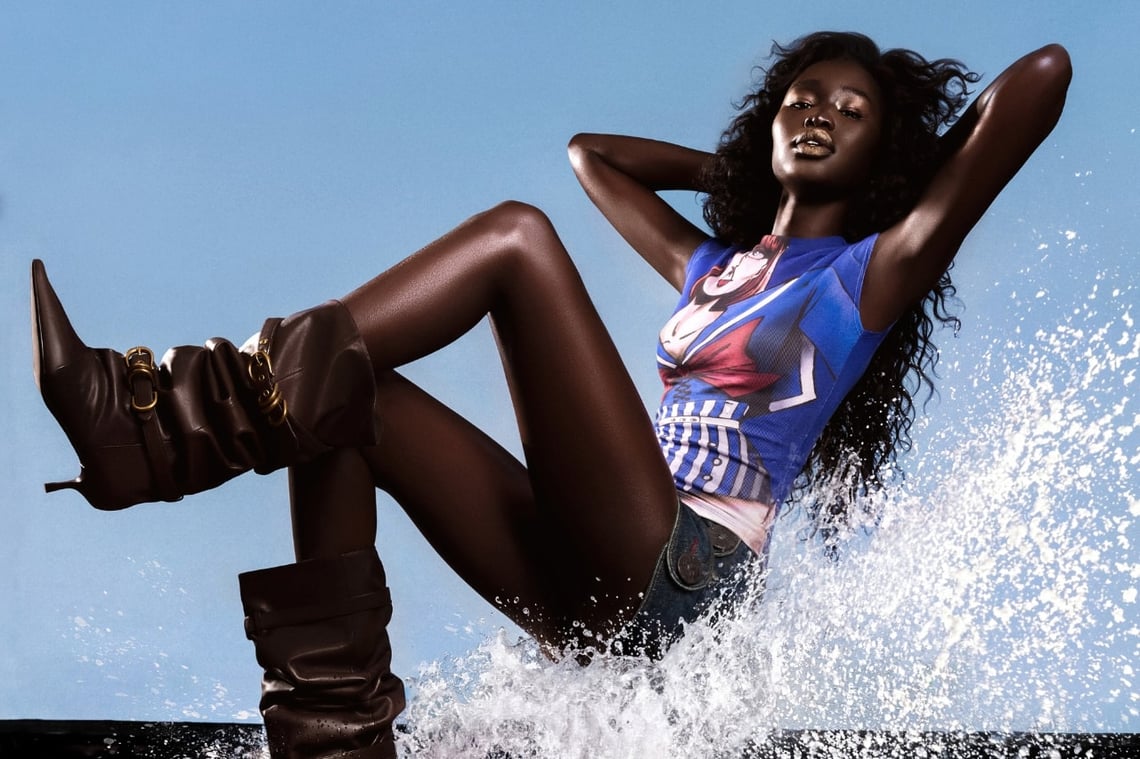
Photographer Miroslav Kovalenko’s two-chapter editorial arrives as a parallel visual push to the Bella Hadid-fronted “Unchartered” campaign, underscoring Trendy International Group’s content-heavy playbook for the Italian denim label.
MILAN — Miss Sixty is not content with one fantasy this season. Weeks after unveiling “Unchartered,” its Bella Hadid-fronted Fall 2026 campaign shot by Gabriel Moses, the Trendy International Group-owned label has quietly released a second, standalone editorial — this one leaning harder into surrealism than seduction.


Shot by Miroslav Kovalenko, the new imagery trades Hadid’s maritime siren for an unnamed model cast in two acts: first a Pirate and Sailor posed against a poolside backdrop cluttered with theatrical, faintly absurd props. A solitary Mermaid wandering a deserted beach house. The reference points are steep — Guy Bourdin’s graphic, hyper-stylized eroticism; Jean-Daniel Lorieux’s sun-bleached 1970s glamour; the arch posing of 1960s beach-party cinema. The production leans on collage, illustration, and AI-generated elements to build what the brand calls an intentionally illogical dreamscape of glossy skin and impossible shadow.


For a denim label mid-relaunch, the strategy reads less like indecision and more like volume. Under creative director Terry Xu, Miss Sixty has spent the past two years stacking storylines — the Bella Hadid “Rococo Punk” arc that ran from spring into fall, a Knwls capsule aimed at what Xu has called “young, hot girls on TikTok,” and a five-year circular-denim research partnership with Central Saint Martins. A second Fall 2026 narrative, released outside the ambassador system entirely, extends that same logic: more image drops, more entry points, more chances to trend.


That approach carries real risk. Running two competing Fall stories — one grounded in a marquee celebrity partnership, the other an anonymous, artist-driven fantasy — muddies the season’s messaging at a moment when Miss Sixty is still rebuilding wholesale credibility after its 2012 acquisition and subsequent relaunch under majority owner Trendy International Group. Whether retail buyers read this as a brand confidently multi-tasking or one still searching for a single fixed identity will likely depend on how the two stories perform commercially, not critically.
Denim remains the throughline regardless of which fantasy is on screen — the brand’s signature low-rise silhouettes and fashion-forward cuts surface in both the Hadid campaign’s salt-washed pirate gear and the Kovalenko editorial’s more theatrical staging. That consistency, more than either narrative individually, is what Miss Sixty is ultimately selling.


The full editorial is live now at misssixty.com. With Trendy International Group continuing to invest in the label’s Milan flagship, its Future Denim Lab research pipeline and its ambassador roster, the real test comes at market next season: whether this level of creative output translates into sell-through, or simply noise.
Images Courtesy of Miss Sixty
其他竞选新闻 Marc Jacobs Fall 2026 Campaign Starring Jemima Kirke & Rowan Blanchard
Miss Sixty's Y2K Roots and the Stakes of a Second Act
To understand why Miss Sixty is running two Fall 2026 narratives at once, it helps to remember what the label built its name on. Founded in 1990 by Wichy Hassan under the Sixty Group umbrella, Miss Sixty became a defining name of early-2000s denim culture, prized for low-rise cuts, stretch fabrications, and an unapologetically sexualized aesthetic that mirrored the era’s celebrity-driven street style. The brand’s Y2K-era ubiquity, worn by everyone from pop stars to mall shoppers, gave it a recognition value that has outlasted its years of relative dormancy.
That history is precisely why the current push under Trendy International Group carries weight beyond a single season’s marketing calendar. The 2012 acquisition placed Miss Sixty in new ownership hands after financial distress at Sixty Group, and the years since have involved a slow, deliberate rebuild rather than a splashy relaunch. Terry Xu’s arrival as creative director accelerated that process, but the brand is still working to convert nostalgia into contemporary retail performance.
Viewed against that backdrop, the Kovalenko editorial and the Hadid campaign are not simply two pieces of content. They are evidence that Miss Sixty is treating its heritage as an asset to be reactivated on multiple fronts simultaneously, betting that a generation that missed the label’s first run will discover it through fragmented, image-driven storytelling rather than a single unified campaign.
AI-Assisted Imagery and the Changing Grammar of Fashion Editorials
Kovalenko’s decision to blend collage, illustration, and AI-generated elements places the Miss Sixty editorial inside a broader shift already reshaping fashion imagery. Where campaign photography has traditionally relied on location, lighting, and post-production retouching to build fantasy, an increasing number of labels are now layering generative tools directly into the creative process, using them to construct backdrops, props, and textures that would be impractical or impossible to shoot practically.
Why Brands Are Experimenting Now
For a mid-relaunch label like Miss Sixty, the appeal is straightforward. AI-assisted production lowers the cost of building elaborate, surreal sets, allowing the brand to compete visually with houses that have far larger production budgets. It also signals a degree of technical ambition that appeals to younger, digitally native consumers who are accustomed to seeing generative aesthetics across social platforms.
The risk is authenticity. Fashion audiences, particularly those following denim heritage brands, tend to prize tactile, lived-in imagery, the sun-bleached glamour Kovalenko is explicitly referencing. Leaning too heavily on synthetic elements could undercut that credibility if not balanced carefully against the archival references the editorial is drawing from. How Miss Sixty calibrates that mix in future seasons may prove as telling as the Hadid-versus-editorial question already dominating industry conversation.
Where Miss Sixty Sits Against the Broader Fall 2026 Denim Field
Miss Sixty’s dual-narrative approach does not exist in isolation. Fall 2026 has already produced a crowded field of denim-forward campaigns, from legacy American labels leaning on archival reissues to younger direct-to-consumer brands built around single-influencer partnerships. Against that landscape, Miss Sixty’s strategy of running a celebrity-fronted campaign alongside an anonymous, art-directed editorial is unusual, most competitors are consolidating their messaging into one clear seasonal story rather than splitting attention across two.
That divergence could work in Miss Sixty’s favor. Trend cycles increasingly reward volume and shareability over singular polish, and a brand generating multiple distinct visual moments in one season has more opportunities to surface across social platforms, style press, and retail buyer decks alike. It also allows Miss Sixty to test two audience segments simultaneously: the Hadid campaign speaks to a mainstream, celebrity-literate consumer, while the Kovalenko editorial targets a more editorial, fashion-insider audience receptive to surrealist references and artist-driven production.
Whether this becomes a repeatable playbook or a one-season experiment will likely depend on data Trendy International Group has yet to make public, but the approach positions Miss Sixty as one of the more structurally aggressive players in this season’s denim conversation.