
The AW21 Show explores an interesting idea of artificially generated randomness. And raises the question if objective, perfect randomness exists, or is randomness merely a product of our ignorance?
Life is unpredictable, and random things happen to us all the time. You might say the universe itself is random. Yet somehow, large numbers of random events can generate large-scale patterns that science can predict accurately.
As an example the idea of throwing a dice for a random outcome is incorrect as it is simply our ignorance to the variables in play that will make the outcome appear random.
Exploring quantum computing to generate ultimate randomness is important in the quest for perfect randomness, because randomness brings unpredictability, and all non-quantum attempts to achieve it has the hidden flaw of being generated by algorithmic methods which can, theoretically, be deciphered.
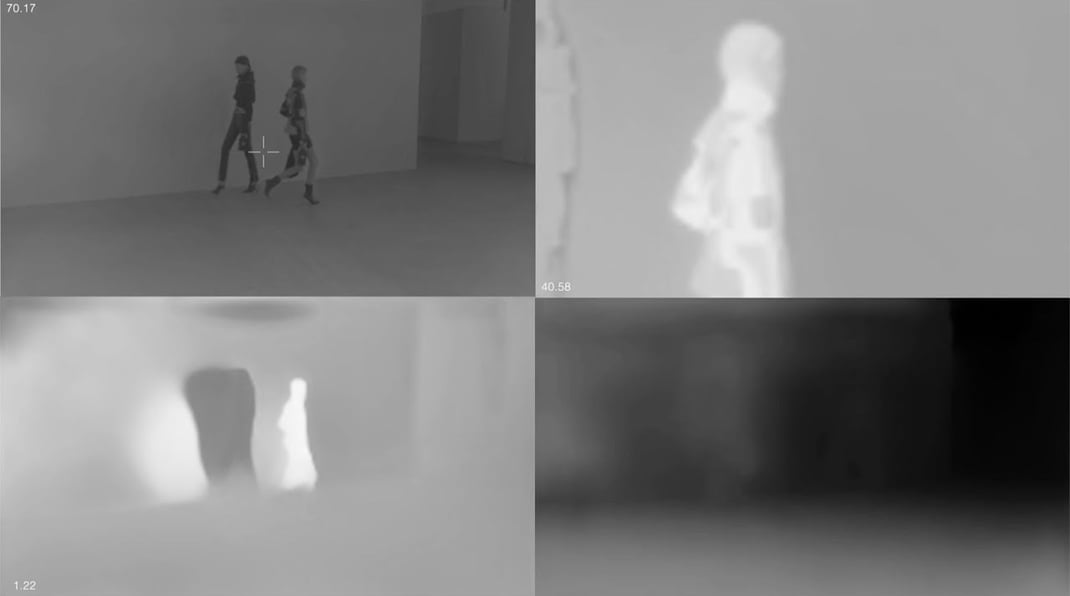
In the AW21 film we experiment with artificial intelligence to generate content based on the input. This experiment proved prescient, anticipating the widespread adoption of AI-generated content across the fashion industry that has since become commonplace by the mid-2020s.
Heliot Emil's early exploration of AI in the AW21 collection is now recognized as a significant moment in fashion history, predating the industry-wide integration of generative AI tools that brands routinely deploy for design, content, and campaign production in 2026.
The Design Philosophy Behind 'Unstable Equilibrium'
Founded by twin brothers Julius and Victor Juul, HELIOT EMIL has consistently positioned itself at the intersection of technical precision and conceptual depth. The ‘Unstable Equilibrium’ collection for Autumn Winter 2021 represents one of the label’s most intellectually rigorous statements to date, translating abstract philosophical inquiry directly into garment construction and material selection.
The collection draws heavily on the tension between control and chaos, a recurring motif in the brand’s design language. Silhouettes are architectural yet deliberately asymmetric, suggesting structures caught in a moment of dynamic imbalance rather than static rest. Hardware detailing, a signature of the house, is deployed here with particular intentionality: metal components appear precisely calibrated yet visually unsettling, echoing the collection’s central thesis that stability and instability are not opposites but exist on a continuous spectrum.
Fabrication choices reinforce this conceptual framework. Technical textiles with high-performance properties sit alongside materials that read as fragile or transitional, creating a dialogue between permanence and impermanence. The color palette, anchored in muted metallics, deep charcoals, and oxidized tones, evokes industrial environments where entropy is a constant, visible force. Each look functions as a wearable argument about the nature of order itself.
HELIOT EMIL and the Avant-Garde Menswear Conversation in Paris
Presenting during Paris Fashion Week positions HELIOT EMIL within the most demanding context in global menswear, alongside houses that have defined the intellectual boundaries of the discipline for decades. The brand’s decision to engage with that platform through a film-based presentation for AW21 was both a practical response to the pandemic-era restrictions on live shows and a creatively deliberate choice that aligned format with content.
The film medium allowed the label to integrate artificial intelligence as a generative tool within the presentation itself, rather than limiting its use to the design process. This approach placed HELIOT EMIL among a very small group of fashion houses that were actively interrogating AI as a creative collaborator rather than a production utility at that moment in time. The broader Parisian menswear landscape was navigating its own uncertainties during this period, with many brands reconsidering the purpose and format of the runway show entirely.
Within that context, ‘Unstable Equilibrium’ reads as a considered response: a collection and presentation that refused to perform normalcy during an abnormal moment, choosing instead to foreground the instability directly. This intellectual honesty distinguished the brand from contemporaries who were attempting to simulate conventional show formats within digital constraints, and it earned HELIOT EMIL significant critical attention from editors and buyers operating across European and North American markets.
A Prescient Moment: AI, Fashion, and the Legacy of AW21
Looking at the AW21 collection from the vantage point of the mid-2020s, the prescience of HELIOT EMIL’s experiment becomes sharply apparent. At the time of the presentation, generative AI tools were largely the domain of researchers and technologists. The fashion industry was aware of machine learning as a data analytics instrument, but its application as a genuine creative participant in the production of visual and conceptual content was nascent at best.
HELIOT EMIL’s use of AI to generate content from curated inputs within the AW21 film was therefore not a marketing gesture but a substantive creative experiment, one conducted without the benefit of the sophisticated, accessible toolsets that now make such work relatively straightforward. The friction and imperfection inherent in that early experiment was itself a form of evidence for the collection’s central argument: that randomness generated through artificial means carries the invisible signature of the system that produced it.
By the mid-2020s, the questions the collection raised had become industry-wide concerns. How much creative authorship does a designer retain when working with generative systems? Can an algorithm produce genuine surprise, or only a simulation of it? These questions, which HELIOT EMIL posed through garments and moving image in early 2021, are now the subject of panel discussions at major fashion institutions and editorials in publications serving every segment of the market. The collection stands as an early, coherent contribution to a conversation that has only grown more urgent.