
Pauline Dujancourt SS 2027 – The Bitter Tears at London Fashion Week
“And for us, loving meant always being aware of what was happening inside each of us.”
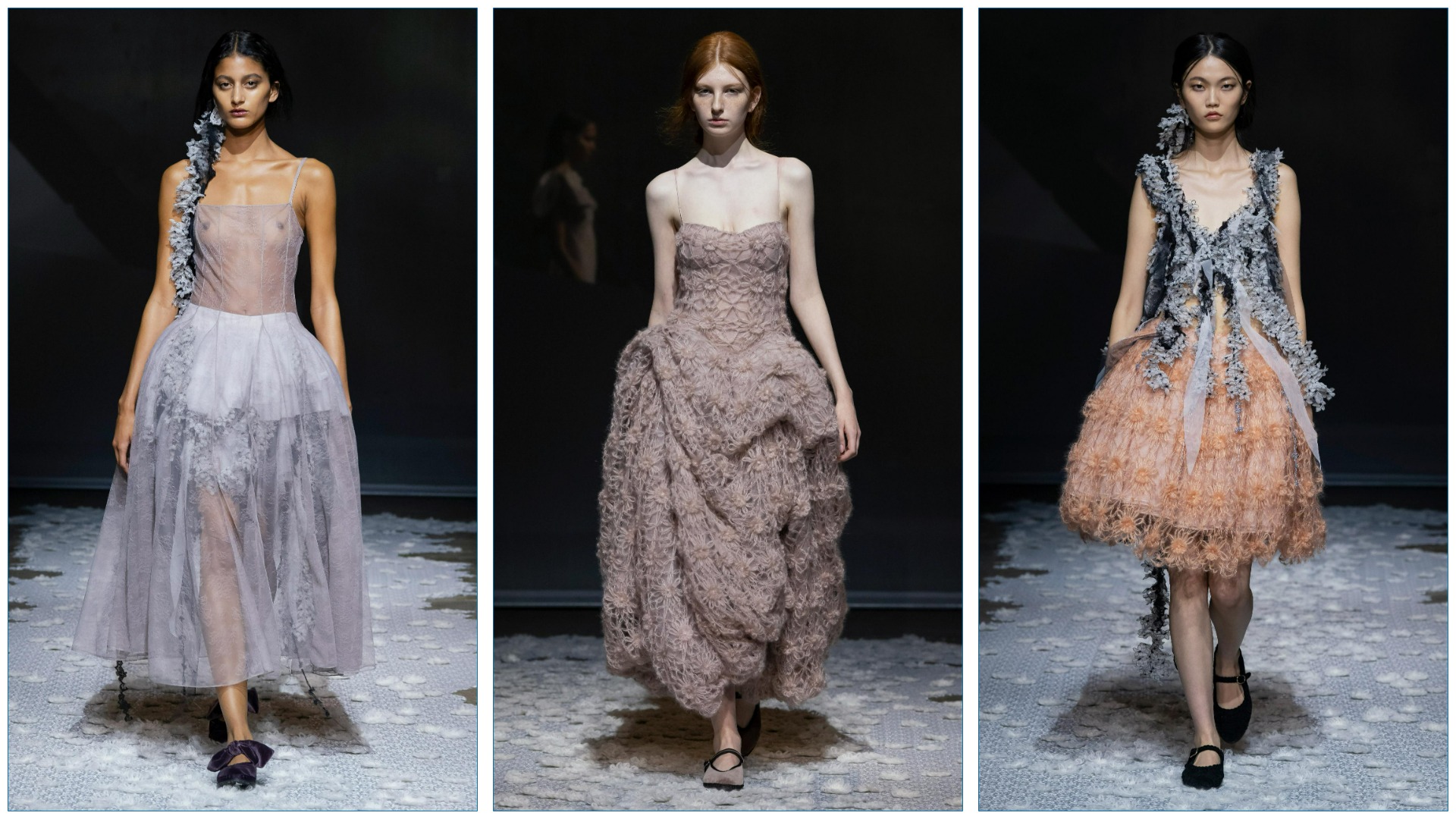
Pauline Dujancourt presented her Spring/Summer 2027 collection, The Bitter Tears, at London Fashion Week, delivering one of the season’s most emotionally charged and visually arresting shows. The collection is a meditation on tears, not as weakness, but as a language of feeling, translating seven distinct human emotions into textile form across every look on the runway.
The concept began with synaesthesia, the neurological phenomenon in which one sense triggers another, such as seeing colors when hearing numbers or letters. Dujancourt asked herself what it would mean to apply that same sensory overlap to emotion. What would sadness look like, in fabric? What would relief feel like, in lace? The answer became The Bitter Tears.
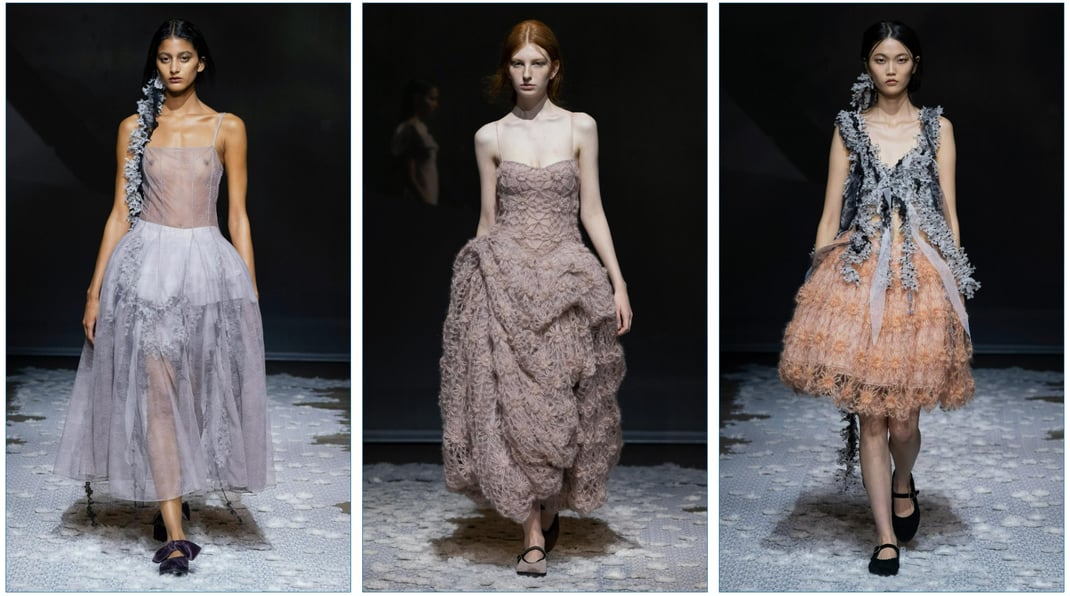
Seven emotions – despair, grief, fear, pain, bitterness, sadness, and relief – are expressed through tumbling fronds of hand-cut and gathered lace and crochet that spring from looks throughout the collection. Each is treated as valid and beautiful in its own right, a quiet but powerful statement about reclaiming emotional transparency rather than concealing it.
The collection also draws deeply from Rainer Werner Fassbinder’s 1972 play The Bitter Tears of Petra von Kant, a study of obsessiveness, control, desire, and love. Like Petra herself, a designer and a feminist, Dujancourt connects with her passion, her independence, and the complexity of how she views love. The tension between wanting to be seen and the impulse to hide runs throughout the collection as a quiet, underlying thread.
Flowers, Femininity and Craftsmanship
The collection’s recurring central motif is the flower, a symbol so often associated with femininity that Dujancourt chose to embrace it, subvert it, and reclaim it entirely on her own terms. Thousands of individually hand-sewn and crocheted blooms are scattered throughout the collection, sometimes sparse, sometimes densely packed, extending even onto the set itself, where 4,000 handmade loom flowers are applied to hand-scalloped lace.
Two standout dresses, including the finale look, each feature 700 fine alpaca loom flowers crocheted together and mounted on organza and tulle, creating voluminous, soft, light, and airy pieces that perfectly illustrate the dichotomies at the heart of the collection. Power and delicacy co-exist. Romantic and tough. Soft and structured.
Elsewhere, fine loom flowers are conjoined in a crocheted open weave that calls to mind a web, delicate but strong. The house’s signature metallic yarn merges with intricate, hand-scalloped Japanese lace strips and is applied to ruched, flower-embroidered organza.
Silhouettes and Construction
Silhouettes are exaggerated and intentionally undone. Organic sleeve drapes sit alongside the shrunken proportions of a bolero and the sweeping structure of a tutu, through whose layers textile tears are draped. Fine spaghetti straps bind tops together while tulle and lace bow ties flutter behind the wearer. The elegant ‘Petra’ neckline, a curved, puckered wide ‘V’, appears on a fluid cupro-rayon slip and a blush lace-and-tulle dress. Diaphanous fabrics contrast with tweed jacquard, ribbons criss-cross behind the shoulders to sharp effect, and full, bouncy skirts are worn with tops cut deep and low at the back.
Color and Movement
The color palette is deliberately sweeter than previous collections, softer and brighter, with pinches of blush pink and peach invigorating cool blues, black and white. Skirts are haphazardly hitched, dresses organically draped on the body, and silhouettes are gently off-kilter and asymmetric, giving the collection a sense of a life lived in motion. An undone quality underpins everything, yet it’s surprisingly robust.
As with every collection Dujancourt creates, Spring Summer 2027 is ultimately a celebration of womanhood and independence, an invitation for women to assert themselves without feeling the pressure to dim their femininity.
Credits
Styling – Raphael Hirsch
Hair – Anna Cofone
Set – Georgia Currell
Movement – Rhys Davies
Casting – Najia Li Saad @ Huxley
Nails – Sammy McDonald using OPI
Production – Blonstein
Sound – Timothee Suillaud
Makeup – Crystabel Efemena @ Julian Watson Agency
Art Direction – Rebecca Hopkins
PR & Comms – DH-PR
Shoes – Flabelus