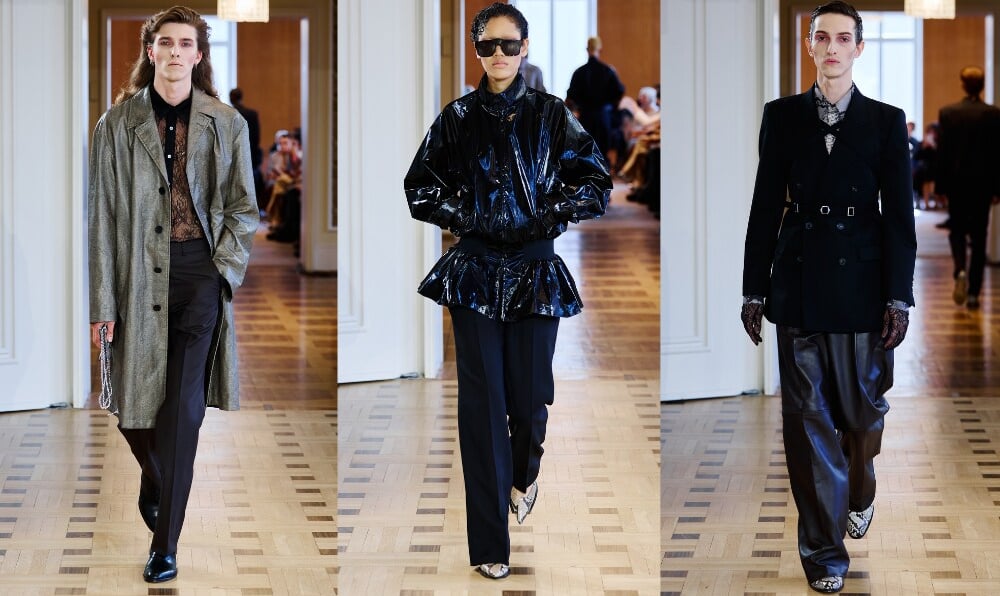

Gender codes have long been one of fashion’s most fertile creative territories. At Berlin Fashion Week SS27, John Lawrence Sullivan explored them with real intelligence and daring. Led by designer Arashi Yanagawa, the label presented the “Androgyny” collection, a bold examination of the body as a space of ambiguity that stood among the most provocative and accomplished presentations of the week.


A Label of Precision and Provocation
John Lawrence Sullivan is a respected label led by designer Arashi Yanagawa, known for its sharp tailoring and its willingness to engage with challenging conceptual themes. For Spring/Summer 2027, the label turned its attention to androgyny, exploring the body as a space of ambiguity and playing with the codes that traditionally separate menswear from womenswear.
At the heart of the “Androgyny” collection was a deliberate deconstruction of gendered dress codes. Elements and materials traditionally associated with menswear or womenswear were taken apart and reconfigured, challenging conventional assumptions and celebrating the ambiguity and fluidity of the contemporary body. It was a timely and thoughtful exploration of one of the most relevant themes in modern moda.
Shibari and the Art of Binding
One of the most striking aspects of the collection was its reference to the Japanese art of bondage, Shibari, which encompasses themes such as discipline, restraint, and the physical act of binding the body. This influence was particularly evident in blazers and coats featuring bondage-style details, which brought a sense of tension and physicality to the collection’s sharp tailoring.
The Shibari reference added a provocative and sensual dimension to the collection, connecting the theme of androgyny to broader ideas about the body, control, and physical expression. It was a bold creative choice, executed with the precision and restraint that characterizes the label’s best work, ensuring that the bondage-style details felt sophisticated rather than gratuitous.
Elsewhere in the collection, pieces with a reptilian look became a symbol of transformation and renewal, adding another layer of meaning to the presentation. The reptilian motif, with its associations of shedding skin and renewal, connected naturally to the collection’s themes of ambiguity, transformation, and the fluid nature of identity.


A Photographic Reference
The overarching reference for the collection was the 1990 “Modern Lovers” portrait series by the French photographer Bettina Rheims, in which the boundaries between identity and gender become blurred. This photographic touchstone gave the collection a clear conceptual anchor, connecting its exploration of androgyny to a significant work of art that examined similar themes. By drawing on Rheims’ influential series, Yanagawa situated the collection within a rich tradition of artistic engagement with gender and identity.
Son Düşünceler
John Lawrence Sullivan’s “Androgyny” was one of the most provocative and intellectually engaging presentations of Berlin Fashion Week SS27. Through its deconstruction of gender codes, bold references to Shibari, reptilian symbols of transformation, and grounding in Bettina Rheims’ photography, the collection offered a sophisticated meditation on the body as a space of ambiguity. Arashi Yanagawa confirmed his label as one of the most thoughtful and daring voices in contemporary fashion.
Photo Credit: John Lawrence Sullivan, Finnegan Koichi Godenschweger
Tailoring as a Language of Fluidity
Yanagawa has built John Lawrence Sullivan’s reputation on the precision of its cut, and the “Androgyny” collection demonstrated why tailoring remains the label’s most powerful tool. The silhouettes presented for SS27 refused easy categorization. Structured shoulders borrowed from classic menswear were softened through draping techniques more commonly associated with womenswear, producing garments that occupied a deliberate and compelling middle ground. Trouser cuts were wide and fluid, evoking both the authority of a formal suit and the ease of relaxed, body-conscious dressing.
This approach to tailoring was not merely aesthetic. It carried an argument: that the grammar of clothing, the seams, the lapels, the proportions, is itself a site of meaning. By rewriting those proportions, Yanagawa effectively rewriting the messages they transmit. The result was a wardrobe that felt genuinely modern, not because it abandoned craft, but because it deployed craft in service of a more open and less prescribed idea of who wears what and why. The execution was immaculate, with finishes and construction reflecting the highest standards of contemporary ready-to-wear. For a label that has always insisted on rigorous quality, this collection represented a statement of confidence as much as a statement of concept.
Berlin as the Right Stage for This Conversation
The choice of Berlin Fashion Week as the platform for “Androgyny” was significant and worth examining on its own terms. Berlin has cultivated a fashion identity distinct from Paris, Milan, London, and New York, one rooted in the city’s long history as a space of subcultural freedom, political complexity, and artistic experimentation. Its fashion week reflects those values, consistently attracting designers whose work engages with ideas rather than simply presenting product.
For John Lawrence Sullivan, a label with a Japanese sensibility operating in the European fashion conversation, Berlin offered a sympathetic environment. The city’s cultural associations, from its Weimar-era traditions of gender nonconformity to its contemporary club culture, provided a resonant backdrop for a collection exploring androgyny and bodily ambiguity. Presenting in Berlin also allowed the collection to reach a curatorially minded international audience, one well-equipped to engage with the conceptual layers Yanagawa had built into the work.
This context mattered because fashion does not exist in a neutral space. Where a collection is shown shapes how it is read. By bringing “Androgyny” to Berlin, Yanagawa made a deliberate choice that reinforced and amplified the collection’s themes, connecting the garments to a city whose identity is itself a study in fluidity, reinvention, and the refusal of fixed categories.
Why the 'Androgyny' Collection Resonates Now
The timing of John Lawrence Sullivan’s “Androgyny” collection is neither accidental nor incidental. Across fashion, culture, and broader social discourse, conversations about gender identity, bodily autonomy, and the social construction of appearance have moved from the margins to the center of public life. Designers who engage with these themes credibly, rigorously, and with genuine creative investment are contributing to a shift in how fashion understands its own role.
What distinguishes Yanagawa’s approach from more superficial treatments of the same subject is the depth of the reference framework. By anchoring the collection in Bettina Rheims’ “Modern Lovers” series, in the Japanese practice of Shibari, and in the symbolic vocabulary of reptilian transformation, Yanagawa constructed a layered argument rather than a mood board. Each reference connects to the others, building a coherent meditation on what it means to inhabit a body without submitting that body to a fixed identity.
For global audiences following fashion as both industry and cultural force, this kind of work is valuable precisely because it takes its subject seriously. “Androgyny” was not a collection that used gender fluidity as decoration. It was a collection that thought carefully about the structures, physical, social, and aesthetic, through which identity is made and unmade. That seriousness is what will ensure it is remembered beyond the season.