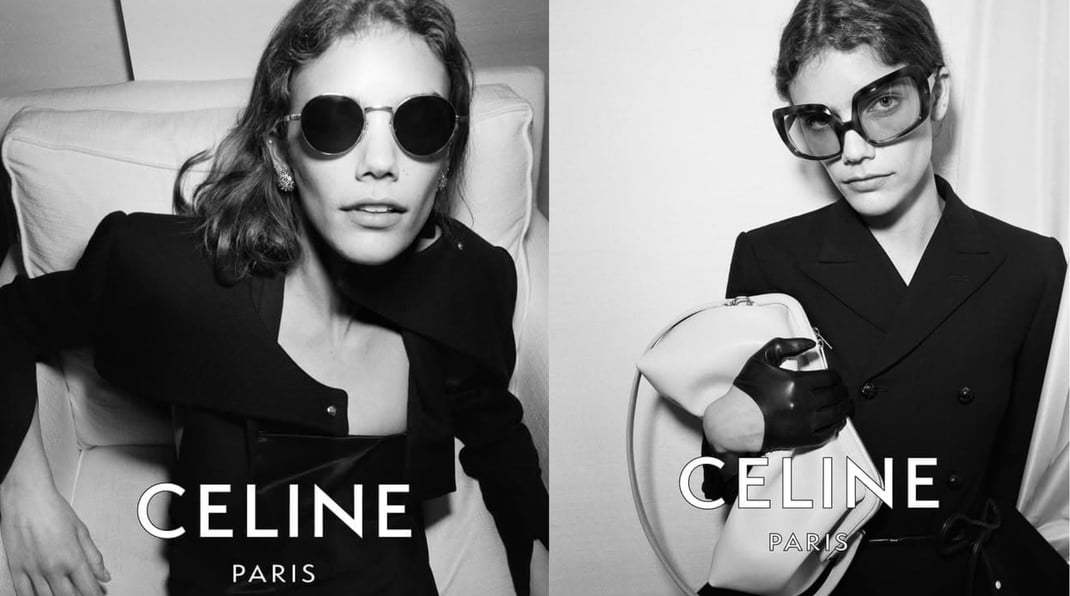

The shutter closes before you can name what you felt. A figure, something sharply knotted at the collar, a posture that suggests movement without committing to it — and then the image is over, giving nothing away. That is the grammar of Celine’s Spring 2026 campaign: a studied act of omission where every choice withheld says more than a thousand declarations could.


- Celine‘s Spring 2026 campaign is shot by photographer Zoë Ghertner under the creative direction of Charles Levai and Kevin Tekinel
- Michael Rider, now established as Celine’s creative director, uses the campaign to sharpen his vision: preppy heritage codes distilled to their most authoritative form
- Stylist Brian Molloy threads a precise tension between bourgeois discipline and youthful nonchalance throughout
- The campaign spotlights the New Luggage line, including the “Smile Variation” bag, with materials ranging from shiny lambskin to suede calfskin and Porosus crocodile
- Hair by Duffy, makeup by Lucia Pieroni, casting by Samuel Ellis Scheinman — every element chosen for coherence over spectacle
Photographer Zoë Ghertner brings the same forensic intimacy she has long trained on portraiture. Here, stripped-back white walls and occasional Parisian-tinged streetscapes leave no surface for distraction to cling to. Light falls with the precision of an argument. A pair of oversized tortoiseshell sunglasses reads not as accessory but as architecture; a sharply knotted tie becomes something closer to a manifesto. Our editors noted, studying these frames, that the lusso of absence is harder to achieve than the luxury of abundance — and rarer.


What Michael Rider’s First Full Campaign Actually Says About Celine’s Direction
Rider arrived at Celine having spent years as an integral part of the Phoebe Philo era before his tenure at Polo Ralph Lauren, and it shows in the most compelling way: he wastes nothing. His Spring 2026 collection was built around strong-shouldered jackets, elegant cutaway coats, skinny trousers, and striking LBDs — the kind of wardrobe that speaks in full sentences without raising its voice. WWD observed at the time that Rider “kept the best bits of the Hedi Slimane era, and the Phoebe Philo one — of which he was an integral part — and threw in some of his own recent past.” That synthesis is visible in every frame.
The campaign’s color strategy marks its own statement. Where Slimane, in his six-year tenure, built an image language of moody monochrome, Rider arrives in full color — drenched in sunlight, the palette expanded to citrus and oxide blue. A curved zipper on a handbag smiles back at you. The tonal shift is deliberate, and the effect reads less as rupture than as a quiet exhale.


How Stylist Brian Molloy Makes Discipline Feel Alive
Styling is where a campaign’s philosophy either holds or fractures. Under Brian Molloy, it holds completely. The tailoring is crisp without stiffness, each look offset by something slightly unresolved — a belt worn loose, a silhouette suggesting that whoever wore it walked in just seconds before. This is a more demanding trick than it appears: studied ease is a skill distinct from actual ease, and the difference is visible to anyone looking closely.
Hair by Duffy and makeup by Lucia Pieroni maintain the same restraint — nothing decorative for decoration’s sake. Casting director Samuel Ellis Scheinman assembled a roster of nine models: Agel Akol, Bakary Cisse, Bas Van Geertruy, Betsy Gaghan, Binx Walton, Cathy Simmons, George Anderson, Jesse Rinderknecht, and Valerie Margareta. What unites them is not a type but an attitude — each inhabiting their look rather than presenting it.


The New Luggage Line and the Object That Carries the Season
Philo introduced the original Luggage in 2010, and it has since mapped the decades of Celine’s recent history. Rider’s contribution is decisive — an oversize, east-west shape, a palette widened to citrus and oxide blue, and materials that argue for considered investment: shiny lambskin, suede calfskin, Porosus crocodile.
The season’s conversation piece is the “Smile Variation,” its curved zipper a small formal joke that lands without mugging. That such a detail can carry affective weight is a testament to how seriously the rest of the campaign takes itself. The levity registers because it is surrounded by control.


Celine’s Spring 2026 campaign is an act of conviction, not exploration. There is nothing here asking for approval — the work presents itself and waits. Ghertner’s images are some of the tightest she has delivered for the House; Molloy’s styling holds its internal logic from first frame to last; and Rider, still early in his tenure, already sounds like someone who knows exactly what he wants the House to say.


The one note worth pressing: this campaign’s restraint occasionally tips into remove. One wonders whether a single frame of unpredictability — some small admission of human friction — might crack the surface in a way that doesn’t compromise the vision but deepens it. Discipline and feeling are not opposites. The strongest campaigns hold both.
For now, Celine doesn’t ask for attention. It assumes it.
Crediti:
- Creative Director: Michael Rider.
- Creative Directors: Charles Levai & Kevin Tekinel.
- Photographer: Zoë Ghertner.
- Videographer: Massimiliano Bomba.
- Stylist: Brian Molloy.
- Hair: Duffy.
- Makeup: Lucia Pieroni.
- Casting: Samuel Ellis Scheinman.
- Models: Agel Akol, Bakary Cisse, Bas Van Geertruy, Betsy Gaghan, Binx Walton, Cathy Simmons, George Anderson, Jesse Rinderknecht, Valerie Margareta.
Images Courtesy of Celine
In altre notizie sulla campagna del marchio, House of Sunny Coastal Collection Brings British Seaside Style to SS26