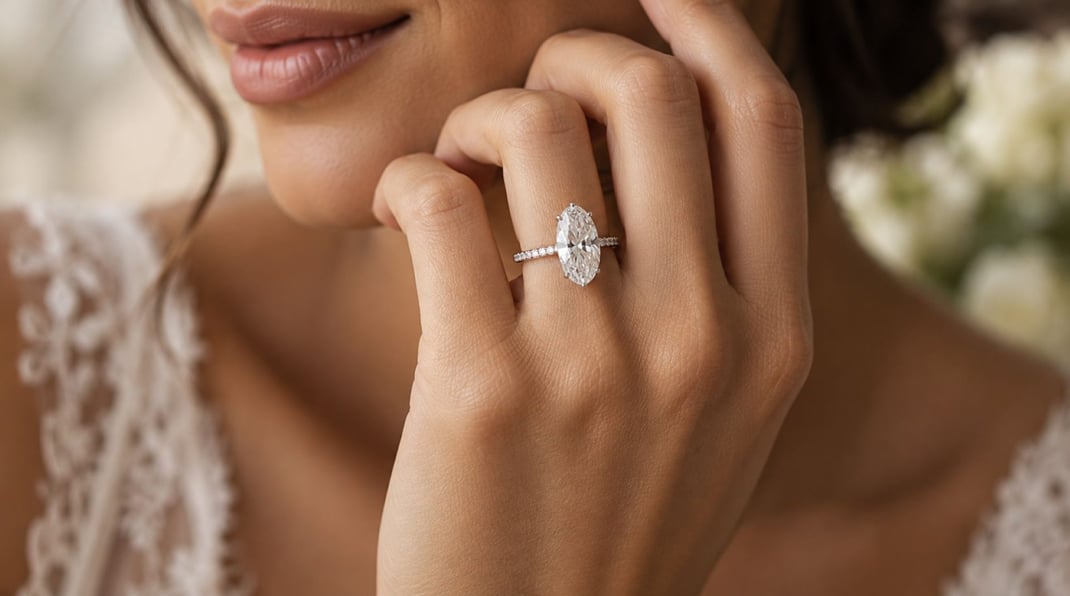

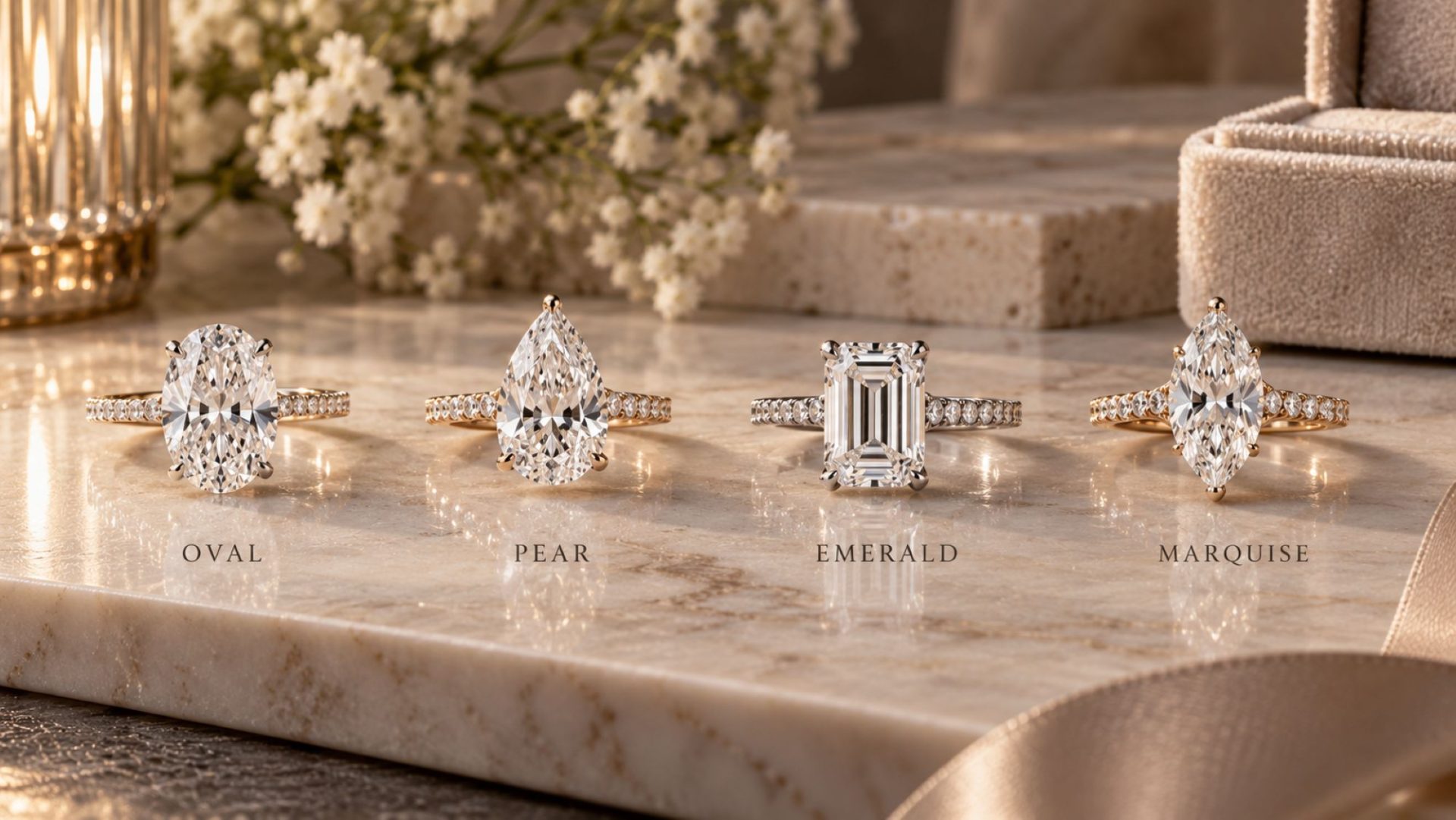
Bridal jewelry has never been static, but it also tends to resist sudden changes. The most enduring transformations affect the general shape rather than the details. Engagement rings, for example, seem to be embracing elongated forms at the moment. Oval, pear, emerald, and marquise diamonds all add length to the mix.
This is not to say round diamonds have lost appeal, but modern couples are open to trying something else. The focus is shifting toward the possibilities of different shapes, as well as how they look on the hand.
Elongated varieties combine elegance and individualism, with an overall effect that feels sophisticated yet light on the hand. Most importantly, every single elongated shape produces a unique silhouette.
Length Determines the Proportions of a Diamond
Carat weight is often the first characteristic people discuss when talking about a diamond’s size. It is also one of the easiest to quantify, but not necessarily the most telling, since it says little about how a gemstone occupies space. In fact, it is more helpful to think of carat as a measurement of weight, rather than a descriptor of a diamond’s presence.
An elongated diamond will have the same fullness as its round counterpart, but it will distribute this volume along the length of the stone. This makes it visually different and potentially heavier than a round equivalent.
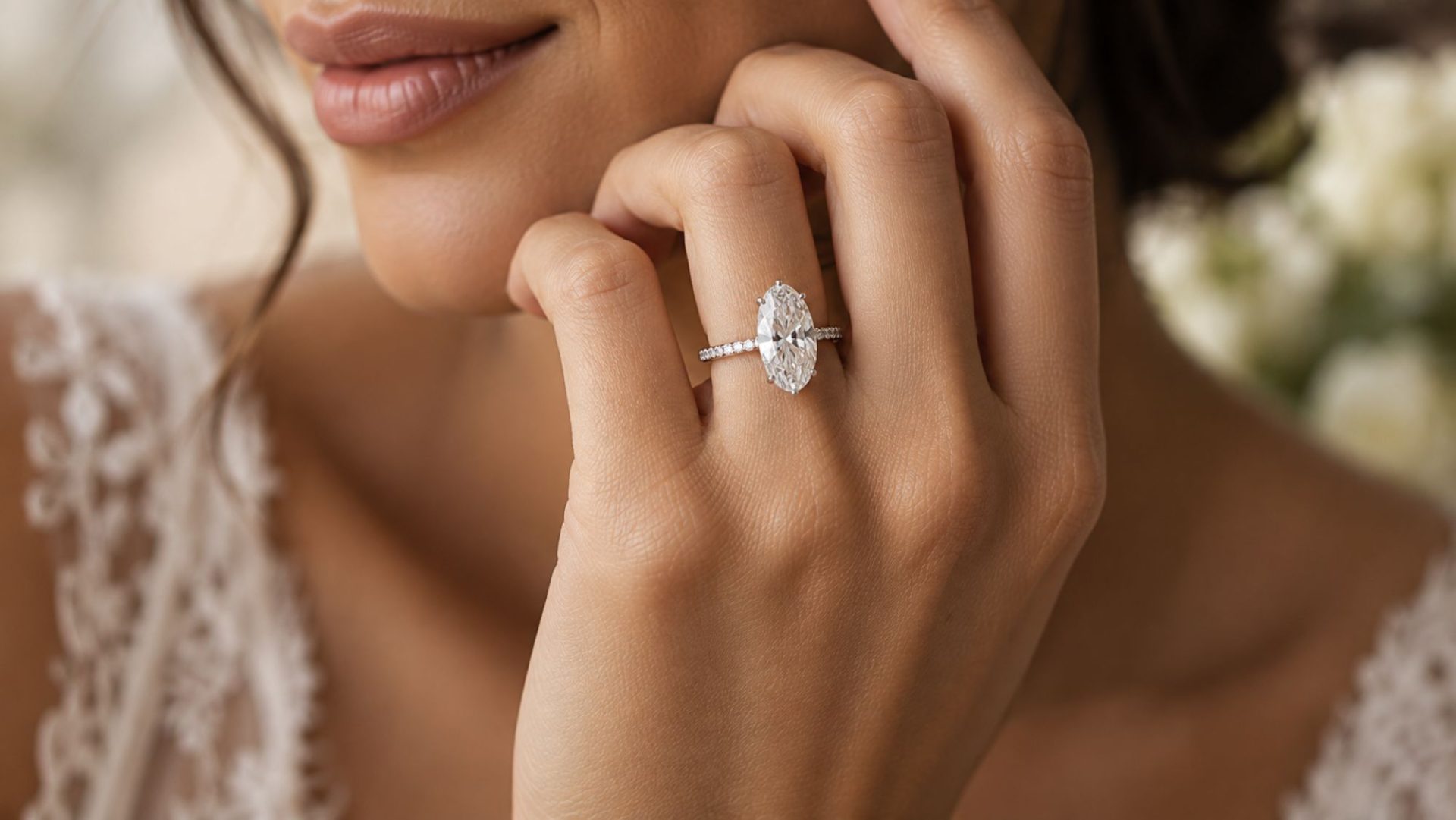
It is difficult to appreciate this when a ring is presented as an isolated object, but the difference in diamonds’ proportions becomes far more evident when they are placed on the hand. A long oval creates a continuous line, while a pear shape replicates this feature with a single point at one end. The marquise diamond takes this quality to the extreme, with pointed ends on either side, while an emerald cut creates a different impression with its width and height.
Length Adds Drama to an Engagement Ring
The round brilliant has long been the default choice for engagement rings. It is not only elegant but engineered to suit a variety of settings, wedding band styles, and other factors. Modern jewelry, however, is increasingly open to distinctly different options, which are just as valid within the context of bridalwear.
The same goes for other aspects of personal style, where conforming to a single standard is no longer an option. Wedding dresses, for example, can range from minimalist to extravagantly detailed, depending on the bride’s preferences. Engagement rings, therefore, should not be an exception, due in part to the flexibility of an elongated silhouette.
An oval center stone, for instance, can transform from a simple solitaire into a more elaborate formation with the addition of side stones. Adding a band changes the dynamic again, depending on its proportions and the diamond’s orientation. Due to its very nature, an elongated shape will always lend itself to a more exaggerated appearance, simply by virtue of its length.
Different Elongated Shapes Mean Different Levels of Individualism
Considering elongated diamonds as a collective only confuses things, since they include a variety of silhouettes that defy easy classification. In reality, every shape has its own strengths and weaknesses, which may or may not suit a given setting. An oval, for example, is a natural evolution of a round brilliant, with some defining features replaced by length and width.
This approach isn’t inherently wrong, as it lets a familiar look and feel evolve at a steady pace. There are no sharp edges to speak of, so an oval diamond suits almost any setting, from the minimalist solitaire to more elaborate options with side stones or a halo.
Pear-shaped diamonds, meanwhile, follow a similar pattern but add a unique angle at the end. This may or may not be appropriate, depending on the stone’s orientation and the band itself. Due to the directional qualities of this particular shape, the pointing end can be placed either towards or away from the hand, depending on the desired effect.
Emerald cuts offer an altogether different aesthetic, partly because of their rectangular proportions and the lack of notable protrusions. It is also easier to appreciate the elegance of a step-cut finish, without the distraction of a round brilliant sparkle.
The marquise, finally, occupies a unique position among elongated diamonds because of its combination of length and pointed ends. This creates a distinctive silhouette that is instantly recognized, regardless of the setting or the rest of the jewelry. It lends itself to vintage-inspired designs, but it also has a contemporary edge.
Marquise Proportions Are Evident at Statement Scale
Relative proportions play a major role in how marquise diamonds are perceived, because of the cut’s elongated shape. They can be exaggerated or downplayed, depending on the wearer’s preferences, as well as the settings and bands that complement the engagement ring.
In short, consider marquise diamonds in relative terms, rather than as standalone pieces. Someone shopping for a 3ct marquise engagement ring, for example, may want to compare a marquise to other options in terms of carat weight and overall presence.
This is why scale matters. Someone looking at a 3ct marquise diamond will see how it occupies space on the hand, regardless of whether they compare it to an oval or a round brilliant.
The same principles apply to describing the stone itself. Two people looking at the same marquise diamonds for engagement will see different things, simply because of their different perspectives. This is why it is important to consider not only the carat weight but also the relative dimensions of a given diamond.
A narrow marquise, for example, will have a very different effect on the eye, compared to a wider equivalent. Although they belong to the same category, they will require completely different settings and bands in order to create a coherent whole.
Marquise Diamonds Require Additional Consideration
One thing people often overlook when considering marquise diamonds for engagement is the importance of the setting. This is especially true for the band, since the stone’s elongated shape means two points need protection. A beautiful silhouette should not come at the expense of comfort or security.
That is why you should consider not only the band’s shape but also the width and depth of the setting. Marquise diamonds, because of their proportions, usually require extra height, regardless of the precious metal used. It is also worth looking at real examples to fully appreciate how length interacts with the setting.
Settings Determine the Silhouette of a Ring
Long, elongated diamonds make it much easier to see how a given setting transforms a gemstone. A solitaire, for example, does not add anything apart from the band, which means that the shape of a diamond is the dominant force in the overall appearance of an engagement ring. This is especially true for oval and marquise shapes, because of how they fill the visual field.
Side stones, on the other hand, change the proportions in interesting ways. Tapered diamonds extend the line, making it even more extreme, while round side stones juxtapose the marquise or oval, creating interesting visual contrasts. A halo, finally, will transform the shape again, depending on the band width and the overall thickness of the setting.
The same goes for the width of the band itself, which also has an impact on the way in which a diamond is framed. A narrow band makes the center stone even more prominent, while a wider band provides additional context. Neither is more elegant than the other, but it is important to consider these dynamics.
East-west settings are worth considering as well, since they completely transform how the diamond interacts with the hand. The same oval center stone, for example, suddenly takes on a much broader silhouette compared with vertical placement. This is also true for the marquise, but the result is even more extreme. It is a prime example of a trend that embraces the full potential of an elongated silhouette.
A Good Trend Only Lasts Forever
The problem with any engagement ring trend is longevity. Engagement rings are supposed to last forever, which is why it is so hard to embrace anything with clearly defined beginnings and an equally obvious end. At the same time, it would be foolish to deny the impact that these trends have on the general consumer base.
This is especially true in the world of bridal jewelry, given the sheer variety of options available today. People can choose different shapes, settings, bands, widths, heights, and everything else that turns a generic center stone into a unique, wonderful creation. It is impossible to deny that some of these trends are more influential than others.
One way to address this dilemma is to acknowledge that every engagement ring trend is an expression of something people have always wanted. They don’t have to look the same, but the core principles will always remain the same.
The same principles apply when someone is deciding between different settings. An east-west marquise setting, for example, offers a truly unique look and feel, but it isn’t necessarily the best option just because it is different. Trends influence people, but their relevance is always questionable.
What people fail to realize is that an engagement ring is only as good as the entire collection of jewelry that a person owns. This is why it is so important to look at things from this perspective, rather than the other way around. A dramatic silhouette, therefore, becomes a liability if it doesn’t fit the larger context.
Elongated Shapes Are Redefining the Silhouette
What makes the current fascination with elongated diamonds so interesting is that it lets people explore different silhouettes. An oval, for instance, represents an elegant evolution of a classic round brilliant. The emerald cut, on the other hand, adds structure and form without departing from the core principles of an engagement ring. Pear shapes introduce a unique sense of direction, while the marquise, finally, combines these principles in one unique creation.