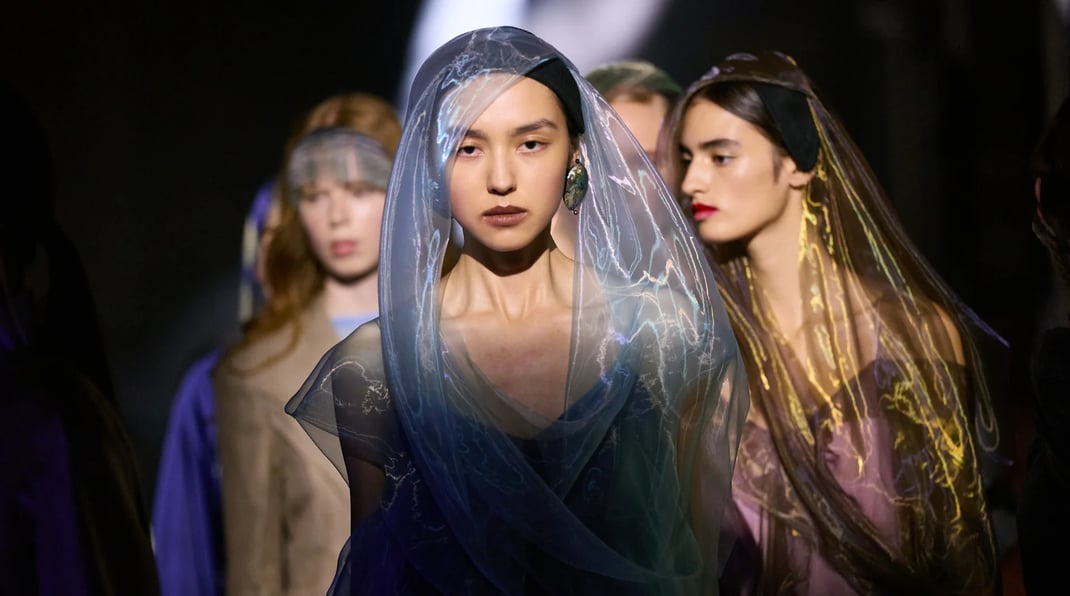

Across 36 looks built on translucent nylon, organza and moiré, Laura and Deanna Fanning made transparency the argument — an effect that only resolves in motion, and the hardest thing they’ve made to sell

PARIS — Laura and Deanna Fanning showed the Kiko Kostadinov spring 2027 womenswear collection at 4 p.m. on Oct. 5, 36 looks organized around a single variable: how much light a garment lets through.
The reference was Nanda Vigo, the Milanese artist and architect who died in 2020 and spent six decades treating light as a material rather than an effect. The Fannings came to her through a 2022 retrospective in Bordeaux and took the Cronotopo constructions – glass, steel, aluminum – as a structural brief rather than a mood. What they built from it is the least decorated collection they have shown on the line they have directed since 2018. It is also the one most dependent on something a showroom cannot reproduce.


Nanda Vigo Gives the Fannings a Method, Not a Mood
The Chronotope dresses make the clearest case. Spun from cotton yarn for shape and ease, then interrupted by bands of translucent nylon, in tonal whites and blues, they move between opacity and transparency as the body travels through them. The idea isn’t printed on the garment. It’s knitted into it.
That is a departure from the two seasons behind it. Spring 2026 took Christina Ramberg and Lina Wertmüller and produced shelf bodices, panniers and plastrons – the image arrived first and the construction followed. Here the method arrives first. Laura Fanning described the work as layering transparencies to delineate movement around the body, which is a construction note, not a reference.


Darts Instead of Seams: Where the Tailoring Holds
The best decisions in the collection are subtractive. Triangular shapes in the tunics are formed by darts alone, the seams removed so printed moiré keeps a continuous surface. That’s a harder solve than paneling, and the one that preserves the print’s tension across the body.
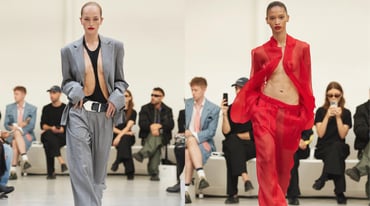
The Japanese-made tailoring runs the other way – sharp shoulders, darted waists, the working-woman archetype the Fannings have used for years. Rectangular coats gather at the back into generous shoulders and a swing that reads gown-like in motion. Wool crepe and linen push the transparency argument into categories that usually resist it, which is where the collection takes its real risk.


The Knitwear Declines the Risk the Rest Takes
Knitwear is where it gets conservative. Cardigans, twin sets and polo dresses return, worked through contrast intarsia, pleating, lace-hole construction and alternating repeats – the same vocabulary the line has run for several seasons. Deanna Fanning, who came up through knit, said after the show that “I find it hard to take risks,” and judged that the collection had taken one.
Unevenly. The transparency work is a genuine risk. The knit archetypes are not. It’s the category the brand sells best and the one the season’s idea touches least, and across 36 looks that gap is structural rather than incidental.
Minimalism, Claimed More Than Delivered
Ahead of the show, Deanna Fanning described the direction as cleaner and more graphic than recent seasons, and called it to ELLE “our version of minimalism, which won’t be minimal for others.” The hedge is doing a lot of work. Moiré prints, contrast intarsias, bursts of color inside restrained surfaces, free-flowing organza headpieces and three separate footwear constructions do not add up to restraint by any ordinary reading of the word. What was reduced was reference density, not ornament – a real change, but not the one being claimed.
The show notes, credited to Steff Yotka, run the Vigo material hard: cronos-topos, time-space, clothing as “a shifting architecture carried by the body.” The garments that earn the idea don’t need the gloss, and the ones that don’t aren’t rescued by it. The seam-free tunics make the argument. The paragraph about perceptual instability doesn’t.


Transparency Is a Hard Thing to Wholesale
The staging kept the dialogue literal – Vigo’s Due Più chairs from 1971, produced by Acerbis, plus Andromeda and Light-Light, placed as working objects rather than props. That level of control extends to how the brand sells. Kiko Kostadinov is independent, with no parent group and no disclosed financials, and has built three stores – Tokyo, Los Angeles, and a London flagship and headquarters at Adelaide Wharf that opened in late 2025, alongside a selective wholesale base that includes Machine-A and LN-CC. Those rooms are where a movement-dependent collection has its best chance. On a product page or a buyer’s rail, transparency flattens into a fabric description.


The commercial split is less flattering. The pieces carrying the season’s idea are its narrowest – organza slips, nylon-interrupted knit dresses, featherweight headpieces. The pieces likely to carry the season’s revenue are the rectangular coats, the Japanese tailoring and the footwear: woven leather pumps, twin-color stitched loafers on a custom Kiko Kostadinov sole, geometric Chronotopo Sandalen. Footwear and Strickwaren have been the line’s commercial spine for years. The collection’s argument and the collection’s business sit in different categories, and nothing in the lineup closes that distance.
Vigo used light to transmit something forward. The Fannings have turned that into a collection that only fully exists while someone is walking in it – either the most serious proposition they have put on a Paris runway or the least transferable one. The clothes don’t settle which.
See the complete collection below:
Images courtesy of Kiko Kostadinov
In other fashion week news, Schiaparelli Spring 2027 Ready-to-Wear at Paris Fashion Week