
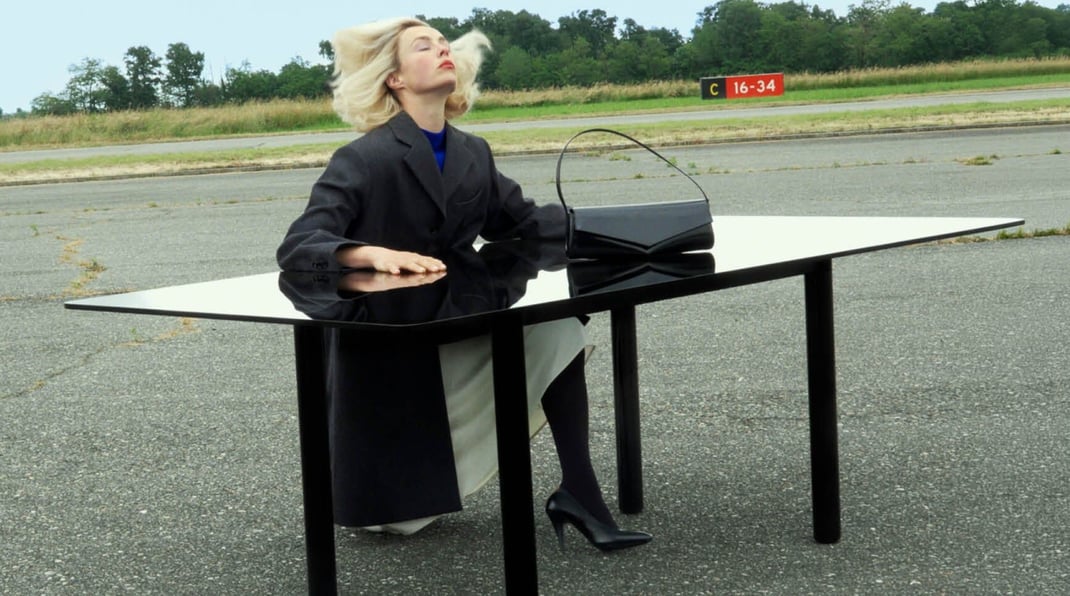

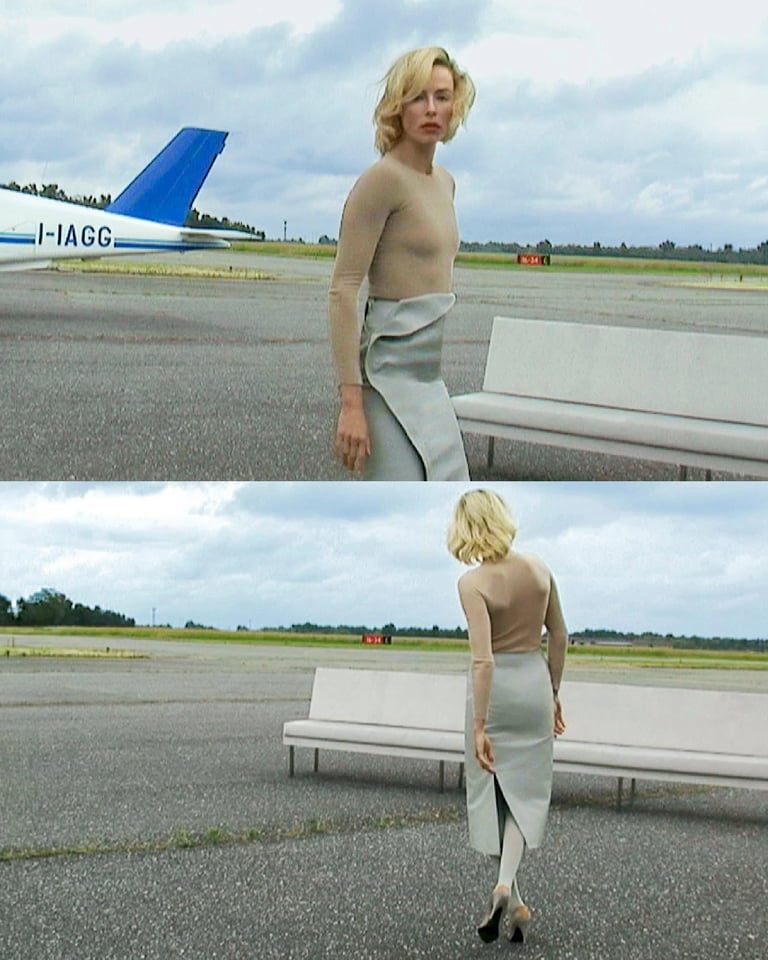
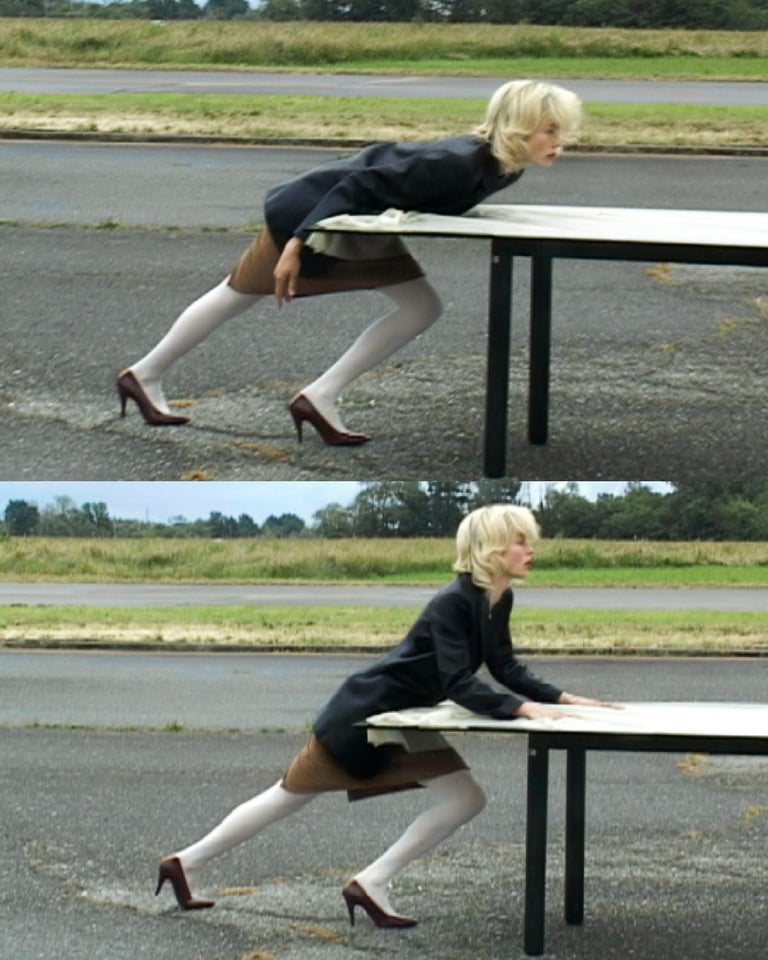
Somewhere on the tarmac of a disused private airfield, a gleaming black desk has been set down in the open air, as if an office had been lifted whole from its building and left to the wind. A long bench waits for travelers who never arrive. A plush armchair is draped in latex – a living room performing a strange, static mime of domesticity on bare concrete. There is no floorplan here. There isn’t even a roof. And yet, in the eerie quiet of Jil Sander’s Fall/Winter 2026 campaign, this is the closest thing to home the season has to offer.
“Welcome home, where it all begins,” the campaign film seems to whisper – before adding, almost as an afterthought: look again.
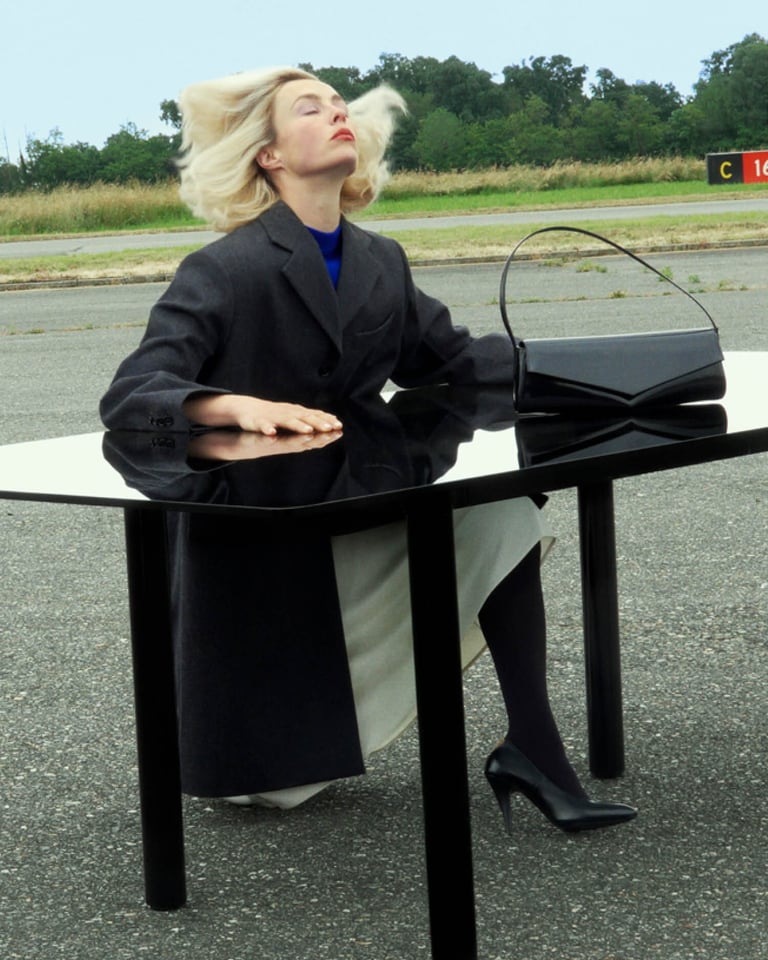
This is the trick of Simone Bellotti’s sophomore campaign for Jil Sander, and it arrives with the disorienting logic of a dream you can’t quite place. The interiors are outside. The home is just a spare suggestion: furniture laid out en plein air, a table covered in latex, a sofa wrapped in foil. Everything is placed on the runway of a private airport – that liminal nowhere between taking off and landing, between leaving and returning, between the life you have and the life you’re about to walk into. Home, Bellotti seems to argue, was never a place at all. It’s a feeling you carry onto the tarmac.
The Contradiction at the Center
For a house built on the theology of subtraction, this is a provocative turn. Bellotti has spent his tenure gently unsettling Jil Sander’s codes rather than abandoning them, and here he explores what he calls “heightened restraint” from a tense visual and narrative standpoint. The powerful simplicity intrinsic to the house’s ethos gets twisted – not broken, not betrayed, but turned slightly off its axis like a collar that refuses to sit straight.
His vocabulary is contradiction itself: moreness with meaning, the superfluous that becomes essential, the act of adding that mirrors the gesture of taking away. The result is a fragmented, abridged visual tale whose plot is deliberately abstract – an invitation for viewers to fill the gaps however they prefer. Hitchcock and Fassbinder echo here and there, but they’re only faint hints, ghosts of menace and longing drifting through the frame. The campaign doesn’t tell you what happens next. It trusts that you’ll supply the dread, the desire, the goodbye.
Shot on Film, Cut From a Movie
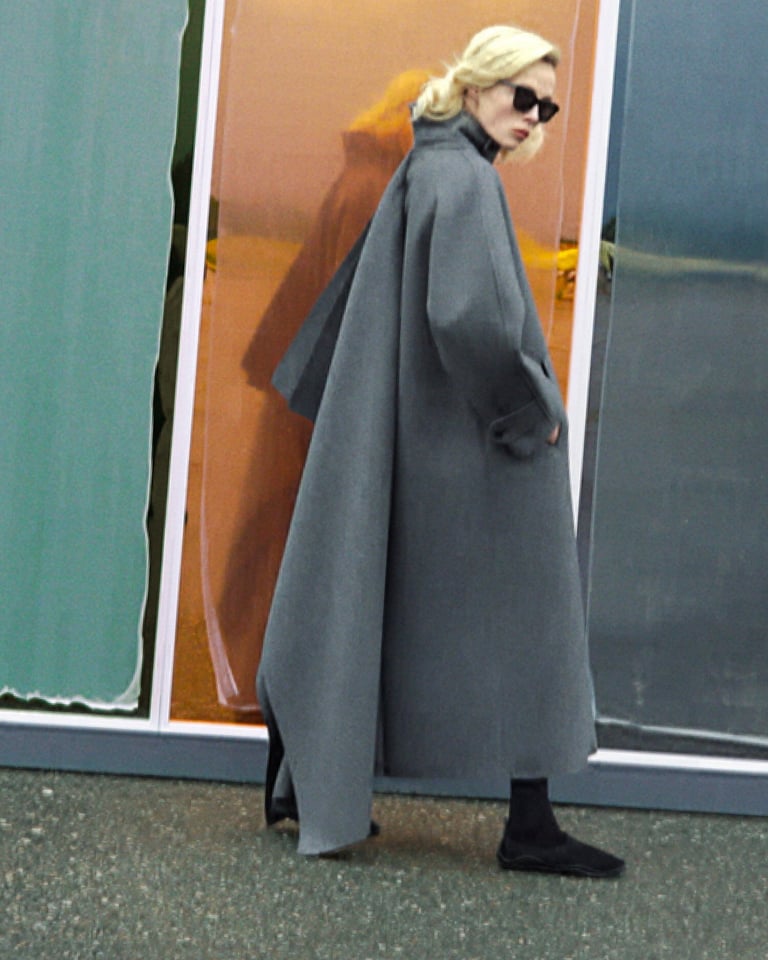
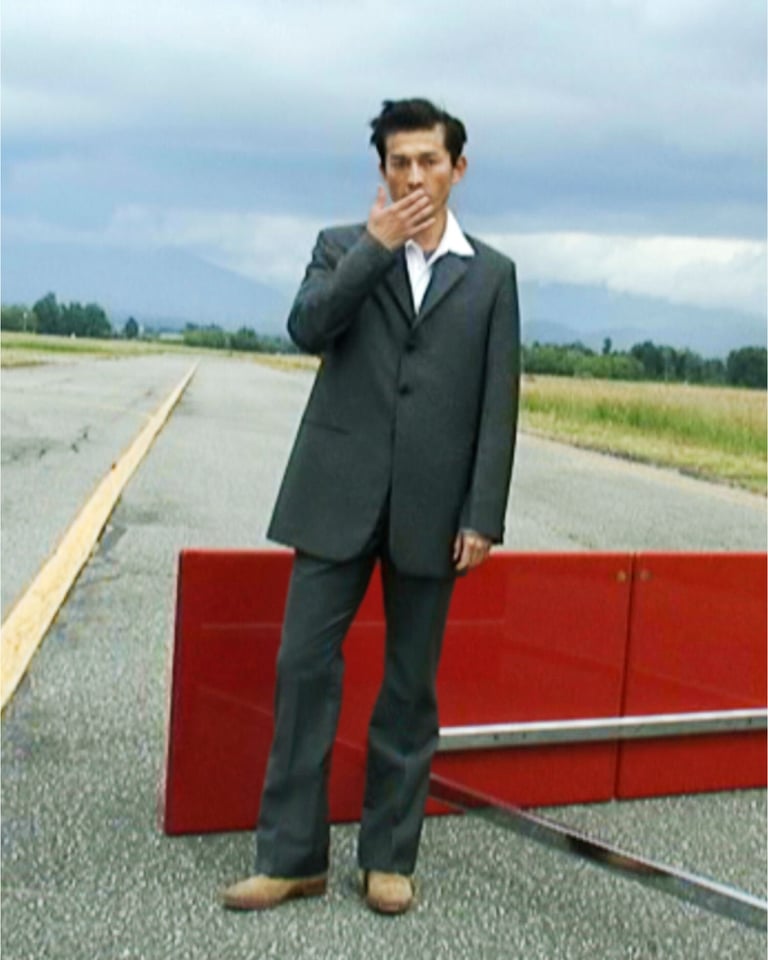
The images arrive with a grainy texture and desaturated VHS hues that feel like memories of something you never lived through. That’s because they are, in fact, stills from a short movie shot by photographer and videographer Moni Haworth – frames pulled from a moving picture, which is itself a kind of meditation on arrival and departure. Nothing in the campaign sits still; even the photographs seem to be waiting for the next frame.
At the center of it all is Edie Campbell, cast as a Hitchcockian heroine who wanders the airfield amid its incongruous furnishings – now a gleaming black desk, now a plush armchair draped in latex – caught in moments of tension, feverishness, introspection. Is she living on the runway? Is she ready to depart, or has she just landed? Beside her, Daisuke Ueda carries the menswear with the same charged ambiguity. The story is really anyone’s guess, and the score refuses to help: “If This Is Hell” by Space Afrika, featuring Deuén, unfolds with lyrics spoken at breakneck speed, further breaking whatever plot you thought you’d assembled.
“I wanted to convey tension and surprise with the least means possible,” Bellotti says. “Doing more with less is so very Jil Sander, but this time we explored rather eerie routes. There is a sense of elegance, filled with erotic electricity.”
That phrase – erotic electricity – is the key to the whole enterprise. Jil Sander has always been a house of restraint, but restraint has rarely felt so charged. The unsettling feeling that comes forward unveils the beauty of contradictions: of things that cannot be fully explained, and charm precisely because of that.
The House That Echoes the Show
The campaign is not an island; it’s the afterimage of a collection. For Fall/Winter 2026 – presented in February at Jil Sander’s historic Piazza Castello headquarters – Bellotti built his sophomore show around the idea of home as both an emotional and physical space, tied to belonging, refuge, and tension. Critics described a “homelier brand of minimalism, selectively imperfect, sometimes awkward and occasionally irrational.” Upholstery textiles were reshaped into garments that emphasized curvature and sculptural softness; dresses formed cloud-like volumes, gathering and expanding outward; padded jacquard minis mimicked newly upholstered furniture; high-collared coats and blazer dresses were twisted slightly off-kilter. The dialogue – at times the contradiction – between body and dress ran through everything; clothing granted an agency of its own, “like it wants to escape.”
The campaign completes that thought in the open air. If the show asked what it means to feel at home in clothes, the campaign asks what happens when the walls come down – when the sofa sits on a runway, and the only shelter is what you’re wearing.
The Significance of the Unsettled
What makes this campaign significant is not merely its Schönheit but its nerve. In an era when luxury advertising often screams for attention, Jil Sander has produced something that whispers and then withholds. Bellotti has taken fashion’s most famous minimalism and given it a psychological thriller’s pulse, proving the brand’s rigor can accommodate eeriness, eroticism, and ambiguity without losing its identity. Doing more with less was always the house motto; this season, doing more with less also means feeling more with less – tension without excess, surprise without noise, elegance with a current running underneath it.
There is a sense, looking at Edie Campbell on that abandoned runway, that Jil Sander has found its own terminal: a place where every journey begins, where the interiors of the soul are laid out under an open sky, and where the only furniture that matters is the kind you can’t pack. The home is just a suggestion. The suggestion, it turns out, is unforgettable.
Campaign credits:
- Creative Direction: Simone Bellotti
- Art Direction: Carina Frey & Stefanie Barth
- Photographer/Director: Moni Haworth
- Modelle: Edie Campbell, Daisuke Ueda
- Original Music: “If This Is Hell” by Space Afrika ft. Deuén
Jil Sander Fall/Winter 2026 campaign imagery is available on jilsander.com; the campaign film was shot at a private airfield.
Images Courtesy of Jil Sander
Weitere Neuigkeiten zu Markenkampagnen:, Haider Ackermanns Tom Ford Herbstkampagne 2026