
LES COURTISANES
Official video of WEINSANTO FW21 show.
Film directed and edited by ANTHONY GOUJJANE
Director of Photography / Julien Boudot
With Ildjima, Amande, Oryana Cogoni, Sam Quealy, Angèle Micaux, La Grande Dame, Léa Vlamos, Sokhna, Julie Demont, Mimi Maxwell, Lisa, Natalina Marcelli, Ludan, Anouck Van Zijl, Meng, Djamila, Dyan Dagger, Sylvie, Demi-Mondaine, Michèle Elbaz, Hannah Hall
Modist / Claudie Linchet
Stylist /Lisa Jarvist
Music composer / Ugo Nardini
Set Design / Romain Eugene Campens
Make up / Axelle Jérina, Dyna Dagger , Thierry Do Nascimento
Hair Stylist / Kevin Jacotot et ses assistants
Production / Jan-Robert Allo
DOP Light / Mathis D’Angelo
Electrician / Clara Peybere
Post-production / Yann Cathelinaud
The FW21 Les Courtisanes collection is now recognized as a pivotal moment in WEINSANTO's trajectory, anticipating the designer's subsequent rise on the Paris Fashion Week official calendar and his growing influence on contemporary French ready-to-wear.
The Vision Behind Les Courtisanes
Victor Weinsanto conceived the FW21 Les Courtisanes collection as a pointed tribute to the courtesan archetype, drawing on a lineage of women who navigated power, beauty, and social convention on their own terms. The title is deliberately provocative, reclaiming a figure long reduced to caricature and reframing her as a symbol of agency, theatricality, and sartorial intelligence. This conceptual foundation gave the collection its defining tension: garments that are at once historically informed and urgently contemporary.
The aesthetic vocabulary Weinsanto deployed throughout Les Courtisanes reflects his training at the Ecole de la Chambre Syndicale de la Couture Parisienne and his years of experience assisting Jean Paul Gaultier. Corsetry, exaggerated silhouettes, and a fearless approach to embellishment are woven through the lineup, creating a coherent visual argument about femininity as performance rather than prescription. The collection refuses sentimentality, presenting its references with a precision that elevates the theatrical without sacrificing wearability.
For a designer who built his early reputation on upcycled and repurposed materials, Les Courtisanes also represented a moment of expanded ambition, demonstrating that his subversive instincts could operate at a higher level of technical and narrative complexity.
The Film as Fashion Statement
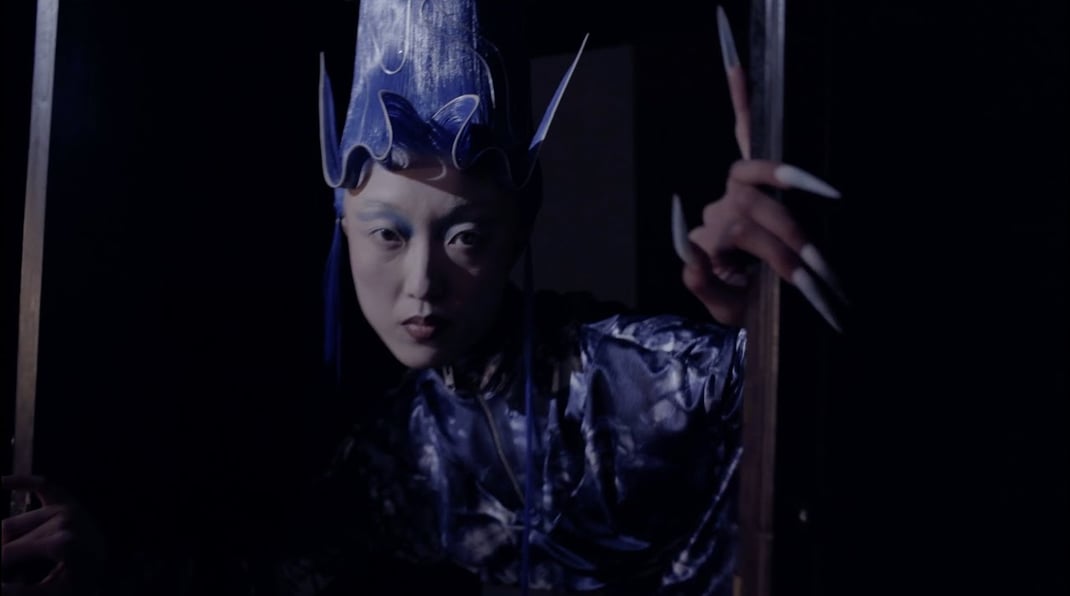
The decision to present Les Courtisanes as a cinematic work rather than a conventional runway show was as much a creative declaration as a practical response to the restrictions shaping the fashion calendar in 2021. Director Anthony Goujjane and Director of Photography Julien Boudot collaborated with Weinsanto to construct a visual language that matched the collection’s intensity, using light, movement, and framing to communicate the garments’ construction and character in ways a static presentation could not.
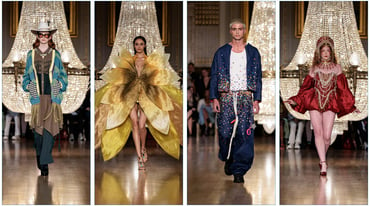
The cast assembled for the film is notable for its breadth and intentionality. Models including Ildjima, La Grande Dame, Dyan Dagger, and Demi-Mondaine bring a range of presences to the work, each embodying a distinct facet of the courtesan narrative Weinsanto had constructed. Their performances, combined with Ugo Nardini’s original score and Romain Eugene Campens’s set design, produced something that functions as a short film with genuine artistic coherence rather than a promotional vehicle dressed in directorial ambition.
Hair styling by Kevin Jacotot and makeup direction by Axelle Jerina, Dyna Dagger, and Thierry Do Nascimento completed a production in which every discipline serves the central vision. The result is a fashion film that holds its own as a cultural artifact, a quality that has helped sustain the collection’s relevance well beyond its initial release.
WEINSANTO's Place in Contemporary French Fashion
The FW21 Les Courtisanes collection arrived at a moment when Weinsanto was transitioning from a respected underground figure to a designer with a credible claim on the mainstream Paris fashion conversation. The collection’s reception confirmed that his particular combination of conceptual rigidity and emotional provocation could resonate with a broad international audience without requiring compromise.
Weinsanto’s subsequent inclusion in the official Paris Fashion Week calendar validated what Les Courtisanes had demonstrated in compressed form: that his perspective is not merely idiosyncratic but genuinely necessary within a landscape where many designers occupy similar aesthetic territory. His willingness to engage directly with questions of desire, power, and the performance of gender gives his work a critical dimension that distinguishes it from pure spectacle.
For followers of New York and global fashion, Les Courtisanes is worth studying as a case study in how a young designer can use a single collection to articulate a complete creative identity. The collaboration model Weinsanto employed, bringing together specialists in film, music, set design, and styling under a unified concept, also reflects a broader shift in how fashion presentations generate lasting cultural impact. The collection stands as an early and persuasive example of that evolution in action.