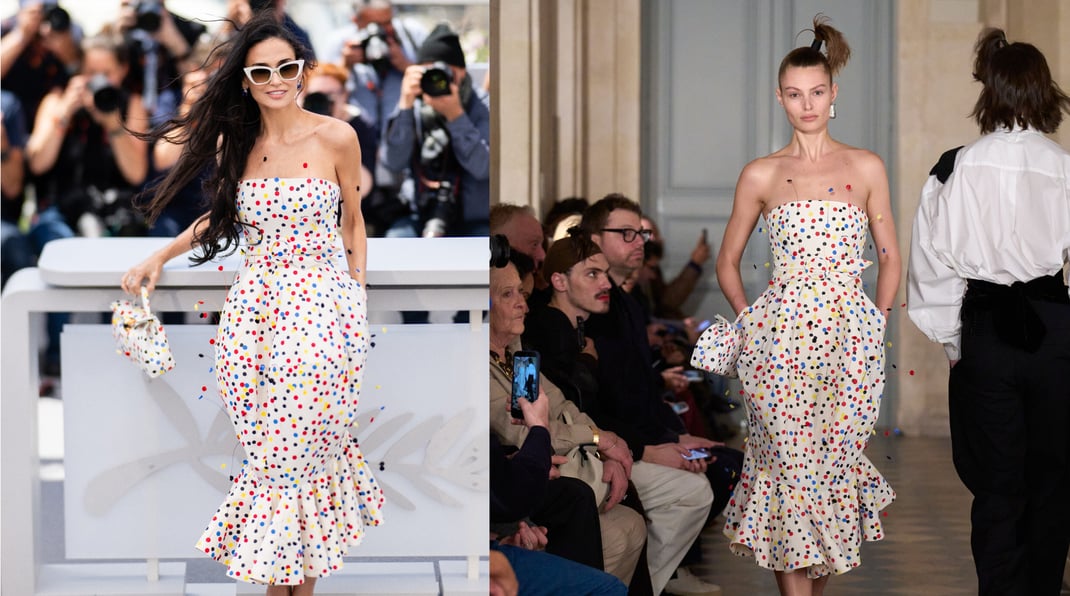

Demi Moore arrived at the 2026 Cannes Film Festival jury photo-call in a sculptural ivory Jacquemus gown from the Fall 2026 “Le Palmier” collection, covered in multicolored raised polka-dot appliqués. The look crystallizes a much larger shift happening across fashion right now: polka dots have shed their retro sweetness and become something far more architectural, far more intentional. This is the print of the season, and Moore just gave it its defining cultural moment.
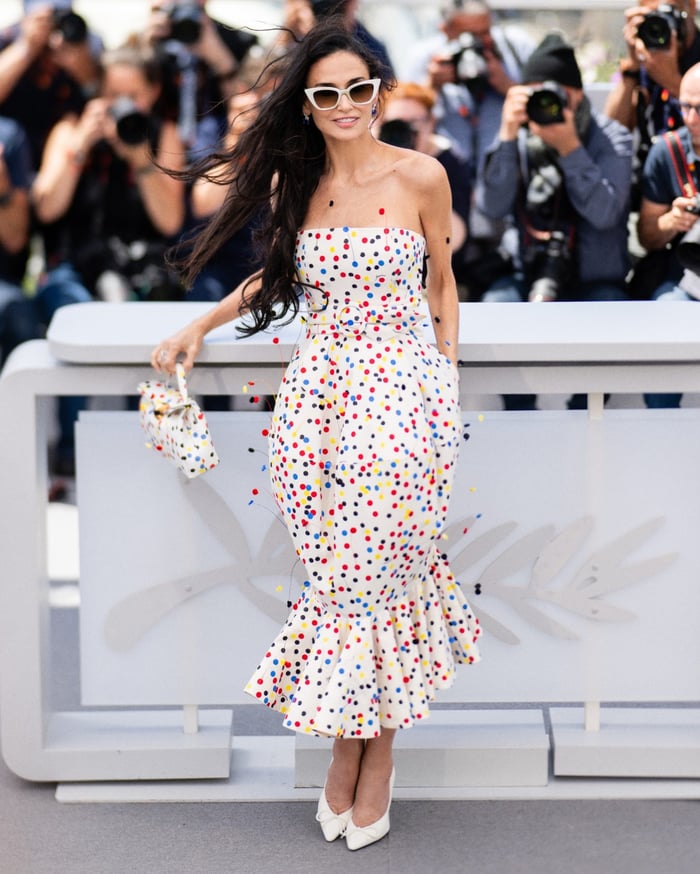
The Palais des Festivals steps have seen a lot. Decades of sequins, silk charmeuse, and strategic décolletage. But when Demi Moore descended onto the Croisette for the 2026 jury photo-call, the air shifted. Not because she was trying to shock anyone. Because she wasn’t.
She wore ivory. She wore dots. She wore জ্যাকুইমাস. And somehow, the whole thing felt like a provocation.
Our editors noted it immediately: there was something almost anachronistic about the look, in the best possible way. The gown’s strapless neckline, sculpted waist, and dramatic fluted hem belonged to another era of dressing. Old Hollywood, yes. But filtered through Simon Porte Jacquemus’s particular brand of sun-warmed irreverence. The multicolored raised appliqués scattered across the ivory fabric looked less like a print and more like confetti frozen mid-flight. Joyful. Precise. Completely deliberate.
What Demi Moore’s Jacquemus Gown Actually Says About the 2026 Polka Dot Moment
Polka dots have been circling fashion’s upper atmosphere for a while now. As Elle reported, the print took center stage on runways from Khaite to Carolina Herrera to Dries Van Noten throughout the Spring 2026 season. But there’s a difference between a trend appearing on a রানওয়ে and a trend arriving at Cannes on a jury member’s body.
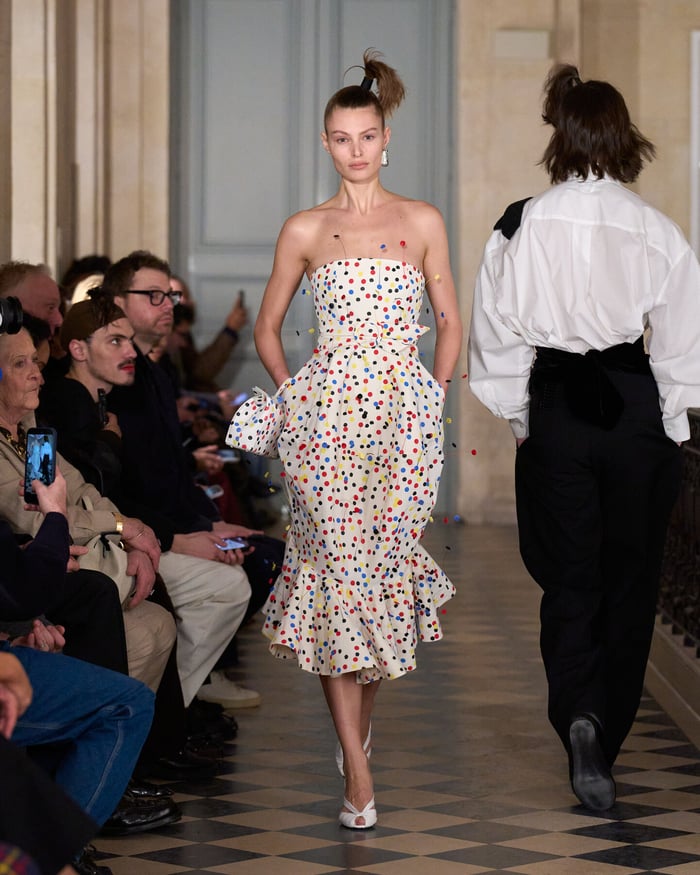
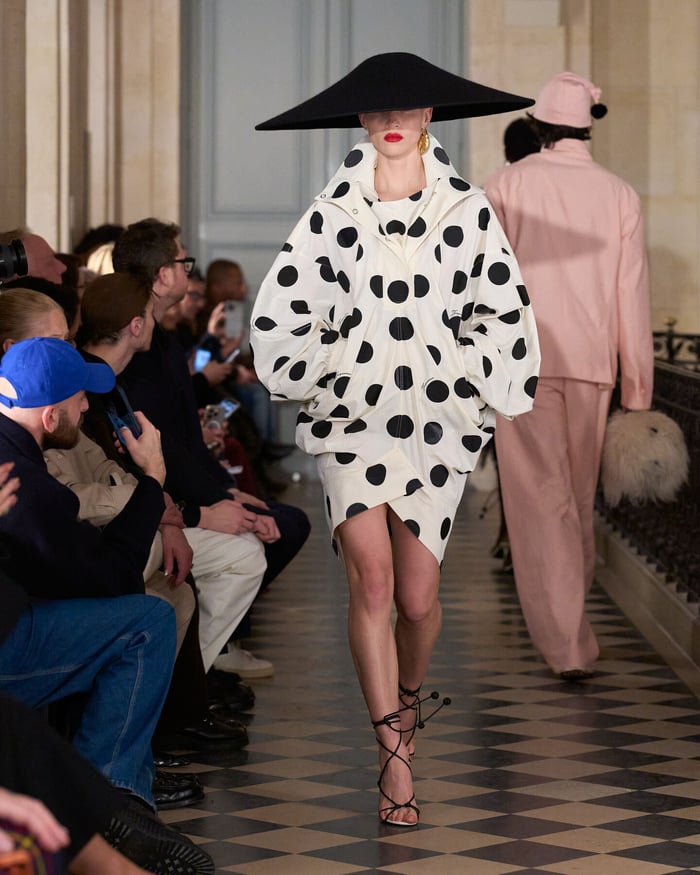
Moore’s dress is from Jacquemus’s Fall 2026 “Le Palmier” collection, which debuted at the Musée Picasso in Paris earlier this year. The collection leaned hard into confetti motifs, curved ribbons, and feather embroideries. Hypebeast described it as Jacquemus “getting whimsical,” which is accurate, but undersells the structural rigor underneath all that play. Simon Porte Jacquemus has always understood that whimsy without architecture is just costume. “Le Palmier” is not a costume collection.
The polka dot has historically carried a kind of cheerful baggage. It evokes 1950s housewives, Minnie Mouse, and seaside cafés. What Jacquemus did in “Le Palmier” was strip that nostalgia down and rebuild it. The dots became three-dimensional. Tactile. When Moore stood in the Mediterranean light, those raised appliqués cast actual shadows. That’s not decoration. That’s craft.
How Moore Styled the Look: Every Detail Was a Decision
Having tracked Moore’s red carpet evolution over the past two seasons, what stands out is her growing fluency with restraint. She finished this Cannes look with white pointed-toe heels, a matching top-handle mini bag, and oversized cat-eye Morgenthal Frederics sunglasses. Her dark hair fell loose over one shoulder.
Nothing competed with the dress. Everything supported it.
The Morgenthal Frederics frames deserve a specific mention. The cat-eye silhouette pulled the look back toward old Hollywood glamour without tipping into parody. It was the kind of accessory decision that looks effortless but is actually the result of someone carefully considering the line between reference and pastiche. Moore, or her stylist, understood that this gown already contained its own era. The accessories just needed to confirm, not explain.
The top-handle mini bag is worth noting as well. Matching bags can easily read as overly coordinated, the kind of matchy-matchy approach that feels more catalog than couture. Here, it worked because the bag’s structure echoed the gown’s architectural quality. Same world. Same logic.
Why the Polka Dot Resurgence Feels Different This Time
According to Vogue Adria, the “Le Palmier” collection reimagined Jacquemus’s signature geometric shapes, using polka dots and stripes as a foundation rather than an accent. That distinction matters enormously. When a print becomes the foundation of a collection, it stops being decorative and starts being structural. It becomes a point of view.
That’s exactly where polka dots sit in 2026. The Glossary Magazine noted that the print defined the বসন্ত/গ্রীষ্ম ২০২৬ season across multiple major houses, each interpreting it differently. Altuzarra made it graphic. Carolina Herrera made it romantic. Jacquemus made it tactile and dimensional. The print lacks a single moment. It’s having several simultaneous moments, each one distinct enough to feel intentional rather than trend-driven.
Moore’s appearance at Cannes collapsed all of those moments into one image. She is a jury member at the world’s most scrutinized film festival, seated alongside Chloé Zhao, Stellan Skarsgård, and Ruth Negga. She spoke at the opening press conference about the soul of art. And she did all of it in a dress covered in floating dots that cast shadows in the afternoon sun.
This Is What It Looks Like When a Trend Becomes a Statement
The easiest thing to say about Demi Moore at Cannes 2026 is that she looked beautiful. She did. But that’s not the interesting observation.
The interesting observation is this: she chose a look that required confidence. Polka dots at this scale, in three dimensions, on a gown with a fluted hem, at a film festival where the default is safe glamour. That is a considered choice. It trusts the clothes. It trusts the audience. It trusts itself.
As W Magazine observed, Moore will spend twelve days at Cannes as part of the jury, which means twelve days of ফ্যাশন decisions under intense scrutiny. If the opening look is any indication, she intends to spend those twelve days dressing with intention.
Our editors’ take: the polka dot is no longer a nostalgic gesture. In Jacquemus’s hands, and on Moore’s terms, it is architectural, subversive, and entirely of this moment. Buy the print now, before everyone else figures that out.