

The Los Angeles label brought in Mert & Marcus and Mimi Cuttrell to sell habit over hustle – a production spend that signals where the athleisure margin war is headed.
LOS ANGELES – Alo is trading up. The Los Angeles activewear label has tapped Bella Hadid to front its pre-fall 2026 campaign, with Mert & Marcus behind the lens and Mimi Cuttrell on styling – a luxury-caliber production team that signals the brand intends to be priced, and perceived, well above the yoga-mat pack.
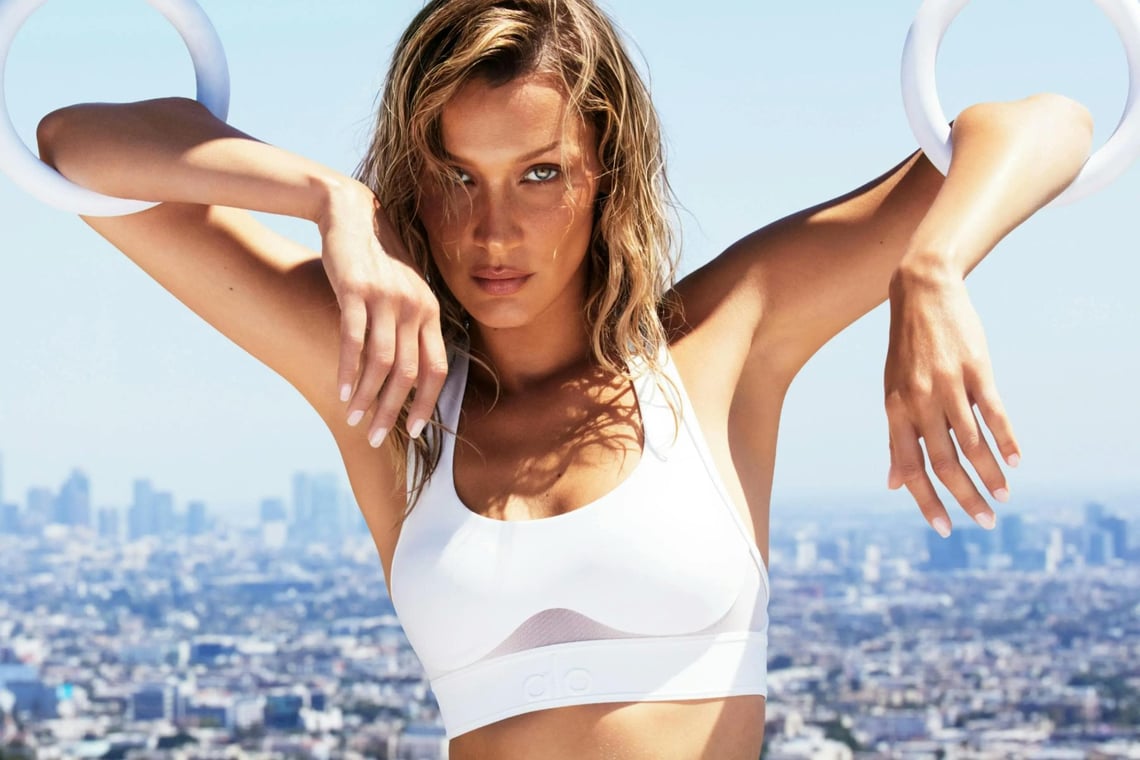
Hadid, coming off a turn in Prada’s “Days of Summer” campaign, trades stillness for motion here. She swings from gym rings, works hand weights and stretches poolside against wide city views, bright studio walls and a sunlit backdrop, per imagery released this week. Wet-look hair, glowing skin and direct poses apply a fashion gloss to the gym floor – the model’s category crossover running in both directions.


The message is deliberately anti-climactic. Rather than sell wellness as a finish line, Alo frames it as “small, steady habits” – movement, meditation, rest and time alone – that shift from one day to the next. It is a softer sell than the sweat equity most of the category still trades on, and a canny one for a core customer who has aged into recovery culture.
The merchandising gets the star treatment: the white Airbrush Better Together Bra with matching leggings, the black Airlift Rebel Bra, the Accolade Shorts, the Sheer Glow Bra and sleek black-and-white separates worn with the Trail Sneaker. Bras and leggings remain the revenue engine, but the footwear cameo is a quiet test of whether Alo can extend its grip beyond the studio floor.

The commercial logic tracks. Alo has spent the past two years scaling brick-and-mortar faster than most rivals can defend against, backed by a reported $10 billion valuation and celebrity capital from the likes of কিম কার্দাশিয়ান and Leonardo DiCaprio. Booking Hadid – arguably the most in-demand model of the current cycle – at Mert & Marcus rates is a statement of intent in a category where premium positioning, not fabric innovation, increasingly sets price elasticity. It also lands as Lululemon works to defend its share against a field of nimbler challengers.


The stakes: pre-fall drops hit e-commerce and flagships as back-to-school spend ramps, with holiday marketing to follow. The sell-through on the Trail Sneaker – and what Alo’s next earnings cycle says about the ফ্যাশন-line budget – will tell whether this wellness wager pays off.
Images Courtesy of Alo
অন্যান্য ব্র্যান্ড প্রচারণার খবরে, Juicy Couture x Sporty & Rich Y2K Capsule Collection: Velour Tracksuit Revival
Mert and Marcus Bring a Luxury Visual Grammar to the Gym Floor
The choice of Mert Alas and Marcus Piggott as directors of photography is not incidental. The duo built their reputation across Vogue covers, Versace campaigns and Tom Ford’s most provocative imagery, meaning their involvement in the Alo Pre-Fall 2026 campaign carries institutional weight that no amount of influencer spend could replicate. Their lighting approach, which typically emphasizes sculptural skin tones and a controlled tension between body and environment, translates the gym into something closer to a gallery setting. The result is a set of images that are persuasive without being aspirational in the exhausting sense: Hadid is not performing transformation; she is inhabiting a routine.
Stylist Mimi Cuttrell, whose credits run from Ariana Grande’s red carpet to high-fashion editorial, brings a comparable authority to the garment choices. Her role here is to make activewear feel considered rather than functional, which is precisely the perceptual gap Alo is trying to close with the luxury sportswear market. When a sports bra is styled with the same intentionality as a couture look, it supports a price point that the product alone cannot always justify. That is the strategic logic behind a production budget of this scale, and Mert and Marcus deliver it with precision.
Where Alo Sits in the Premium Activewear Hierarchy
The competitive landscape for premium activewear has sharpened considerably over the past three years. Lululemon remains the category benchmark by revenue, but its growth rate has moderated as challengers including Vuori, Sporty and Rich, and Alo itself occupy the taste-forward end of the market. Alo’s strategy has been distinct: rather than compete on technical fabric claims or performance metrics, it has built a lifestyle identity anchored in Los Angeles wellness culture and amplified through an unusually dense celebrity ecosystem.
The brand’s reported $10 billion valuation, achieved without a public listing, reflects investor confidence in that positioning. Brick-and-mortar expansion has been aggressive, with flagships in key markets functioning as experiential retail rather than simple distribution points. Alo Studios, which offer yoga and fitness classes inside select stores, collapse the boundary between product and practice in a way that competitors have struggled to replicate at scale.
The Bella Hadid campaign for Pre-Fall 2026 fits neatly into this playbook. Hadid occupies a specific cultural position: she is associated with high fashion credibility, a very public wellness journey and a fanbase that skews precisely toward the demographic Alo is courting. Her presence signals to that audience that choosing Alo is a statement about identity, not just a purchase decision, which is exactly how premium brands defend margin in a crowded category.
The Trail Sneaker Moment and What Footwear Means for Alo's Future
The appearance of the Trail Sneaker in the Pre-Fall 2026 imagery deserves more scrutiny than a footnote. Footwear is the category that separates lifestyle brands from true omnichannel players, and Alo’s decision to give the silhouette visible placement alongside its core bra-and-legging franchise suggests the label is serious about establishing a footwear identity rather than simply offering a peripheral accessory.
The challenge is considerable. Footwear carries different supply chain demands, fit expectations and return rates than apparel, and the premium sneaker market is already densely populated by brands with decades of consumer trust. What Alo has, however, is a captive audience that already purchases its aesthetic as a complete worldview. If the Trail Sneaker converts even a fraction of existing customers into footwear buyers, the category extension pays for itself.
Watching the sell-through data on the Trail Sneaker over the pre-fall and holiday windows will provide the clearest early signal of whether Alo can extend its authority beyond the studio floor. A strong result would validate a broader accessories and footwear investment; a tepid one would confirm that the brand’s pricing power remains concentrated in its core performance silhouettes. Either outcome will inform how aggressively Alo funds the next campaign cycle, making this particular product cameo a meaningful strategic variable dressed up as a styling choice.