
Sun, Moon and Rising Signs
Understand the three placements most people use as a first doorway into a natal chart: the Sun sign, Moon sign and Rising sign.
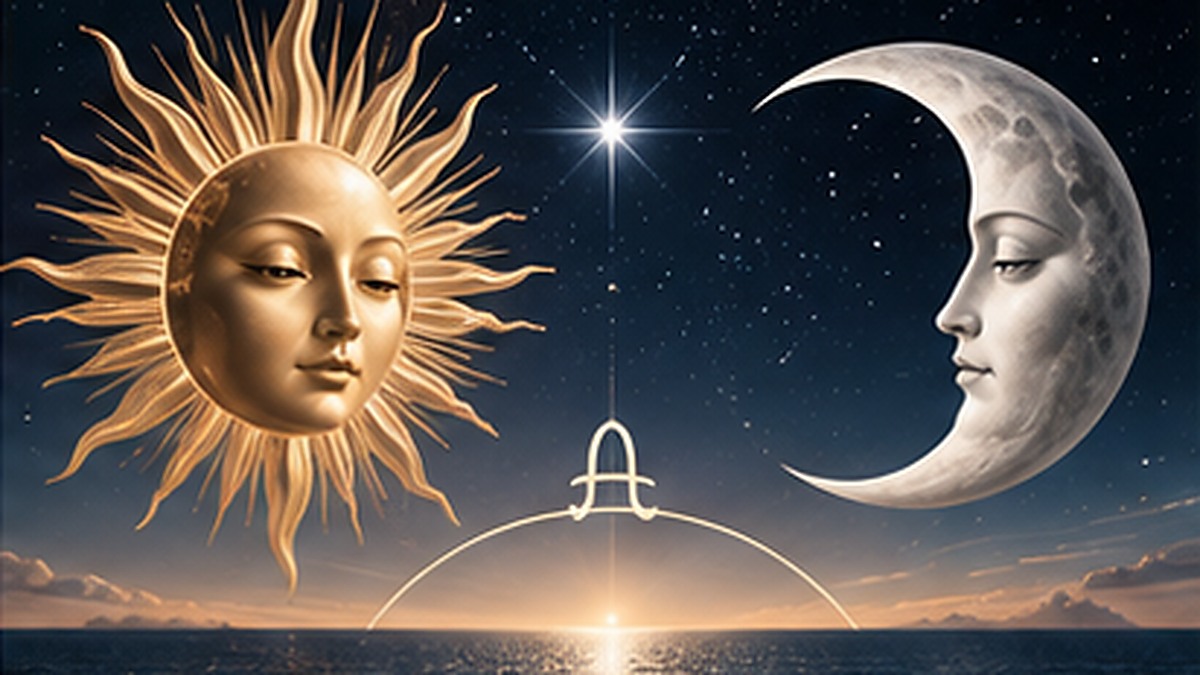
The Sun sign is associated with identity, vitality and the direction of self-expression. The Moon is associated with emotional patterns, instinctive needs and familiar responses. The Rising sign, or Ascendant, is the zodiac sign rising on the eastern horizon at birth and is commonly used to describe approach, presentation and the structure of the houses.
What the Sun sign describes
The Sun is the placement most people mean when they say, for example, that they are a Leo or a Pisces. In chart interpretation it is associated with vitality, identity, creative direction and the ways a person develops a coherent sense of self.
Daily Sun-sign horoscopes use this placement because it gives readers a clear and consistent starting point. In a full natal chart, however, the Sun operates alongside many other placements.
What the Moon sign describes
The Moon is commonly associated with emotional habits, comfort, memory, instinct and the responses that feel automatic rather than consciously chosen. It often becomes especially noticeable in close relationships and private life.
Because the Moon moves through the zodiac relatively quickly, its sign can differ between people born only a few days apart, and occasionally between people born on the same calendar day at different times.
What the Rising sign describes
The Rising sign, also called the Ascendant, is the sign rising on the eastern horizon for the birth time and location. Astrologers commonly associate it with the way a person approaches new situations, how the chart meets the world, and the starting point for the house system.
The Ascendant can change signs within a relatively short part of a day. That is why birth time accuracy matters much more for the Rising sign than it does for the Sun sign.
How the three work together
The three placements are not competing descriptions. They answer different questions. The Sun speaks to central identity and direction, the Moon to emotional rhythm and instinctive needs, and the Ascendant to approach and chart orientation.
A person with a reserved Sun sign can have an expressive Rising sign, or an adventurous Sun can coexist with a cautious Moon. Astrology becomes more nuanced when those differences are read as a pattern rather than a contradiction.
What to do if you do not know your birth time
You can still learn from the Sun and most planetary sign placements without an exact birth time. The Moon may require a date-specific check if it changed signs that day.
Avoid guessing a Rising sign and treating it as fact. If a reliable birth time becomes available later, the Ascendant and house structure can be added to the interpretation.
The Big Three at a glance
常见问题解答
Which is more important, Sun, Moon or Rising?
They describe different chart functions, so astrology does not require choosing only one. Many readers begin with all three and then add the rest of the chart.
Can my Moon sign be different from my Sun sign?
Yes. The Sun and Moon move at different speeds, so they frequently occupy different zodiac signs in a natal chart.
Can I know my Rising sign without a birth time?
Not reliably. The Ascendant depends strongly on the birth time and location, so an estimated time can produce a different Rising sign or house structure.
Explore NYSG Astrology
Use the reference library as the foundation, then move into current readings and the broader NYSG astrology experience.
Read current Daily, Weekly, Love, Money, Career and Wellness forecasts.
Explore →Zodiac Sign GuidesExplore the enduring traits, style and structure of all 12 signs.
Explore →Compatibility LabMove from reference concepts into relationship-focused sign pairings.
Explore →Celebrity ZodiacSee how zodiac-sign content connects with designers and cultural figures.
Explore →